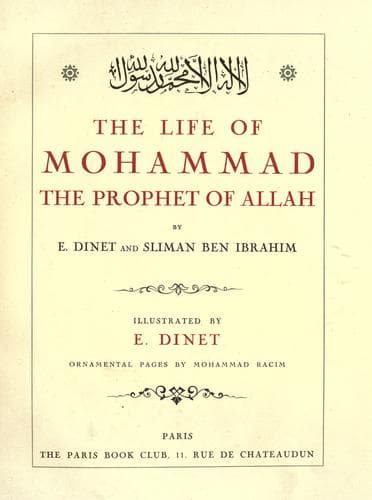
The Life of Mohammad, the Prophet of AllahDinet, Etienne
Religion
The Life of Mohammad, the Prophet of Allah
Dinet, Etienne
Muhammad, Prophet, -632
In short, the only system of decoration which, with the exception of
Calligraphy, borrows nothing from Nature: geometrical ornament--from
which the Greek and Latin races merely derived poor and frigid
effects--became endowed with real life. Henceforward this decoration
was significantly labelled as Arabesque and, following the example of
its model, it tried skilfully to astonish the mind by straying in the
midst of the most inextricable entanglements and unexpected
transformations....
How precious are the creations of Moslem art! European amateurs nowadays
outbid each other in golden offers for its vestiges, hoping through them
to introduce into their homes a few gleams of the mirages that inspired
their authors. Radiant stained-glass, variegated glassware, stuffs
worked with gold or silver wire, sparkling silks, damaskeened, inlaid
bronzes, exquisite miniatures in the dwellings of the West, do they not
all sing the glory of Islam? Among all these treasures, connoisseurs
already begin to prefer those of Calligraphy which animates the
transcription of the divine verses by the delicate colouring of copies
of the Qur'an, or of the thick enamel of earthware. By so doing, the
buyers of Europe follow the example of Mussulman princes of the best
epoch who, to possess a page of calligraphy by a celebrated artist,
lavished madly as much money as is given in our time for masterpieces of
painters. May not these sacred inscriptions, causing their new
possessors to be thrilled with admiration by reason of the refined
elegance of their form, reveal one day to their purchasers the sublime
beauty of the Islamic soul lurking in these writings?
[Sidenote: INFLUENCE OF MOSLEM CIVILISATION IN EUROPE DURING THE
MIDDLE AGES AND THE RENAISSANCE]
Even at a period when Europe was not inimically inclined towards
Islam, it was dazzled by all its marvels and borrowed largely from the
decorative and architectural genius of the Arabs. Deep research would
soon prove that it owes much more to it than to Greek or Latin
antiquity. Such a study would take us too far from our subject. We
may, however, point out as a curious fact that, according to the
historian Dulaure, Arab architects were employed in the work of
building the Parisian cathedral of Notre Dame.
In the domain of science, the influence of the Moslems was just as
fertile. To give an idea thereof, we cannot do better than summarise
the opinion vouchsafed by Doctor Gustave Le Bon, in his remarkable
work: _La Civilisation des Arabes_. (_The Civilisation of the Arabs._)
"First of all, it must be acknowledged that it is to the Arabs that we
owe entirely the idea of experiment and observation, the basis of
modern scientific methods, overriding the authority of a master. This
substitution is therefore not the work of Bacon, to whom it is
generally attributed.
Public-domain text, read in full here on John Shaqi.
Reviews
Reviews
No reviews yet
Be the first to share your thoughts on this work.
Elsewhere in the archive
Join the Discussion
Join the discussion
Sign in to leave a comment or review.
Sign InorCreate an account