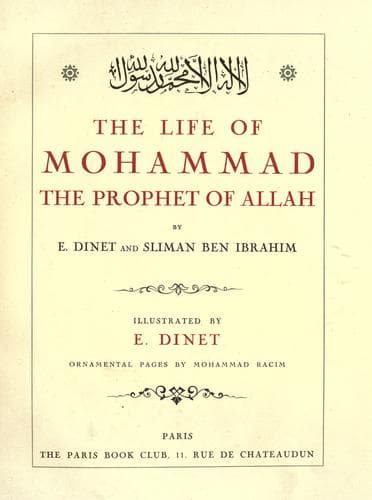
The Life of Mohammad, the Prophet of AllahDinet, Etienne
Religion
The Life of Mohammad, the Prophet of Allah
Dinet, Etienne
Muhammad, Prophet, -632
It would be absurd to maintain that his direct example served to guide
the French Revolution which was not inspired by much of his levelling
works. Nevertheless, the first attempts of this enfranchisement of
ideas and the organisation of modern society on a new basis--and of
this there is ample proof--resulted logically from his doctrines.
Honour is due to a Mussulman philosopher, Ibn Rushd, or Averroes, who
lived in Spain from 1120 to 1198, for being the first to introduce
freethought--not to be confused with atheism--into Europe.
Averroes opposed the pure deism of Islam to mythological pantheism and
Christian anthromorphism, and his 'Commentaries of Aristotle,'
although vividly coloured with Mussulman tints, impassioned all
independent minds in medieval Europe. Averroism, born of this
enthusiasm, may be justly considered not only the precursor of Reform,
but also the father of modern Rationalism.
The influence exercised by Mussulman customs over those of Europe was
equally healthful. The Arabs joined most chivalrous manners to extreme
religious tolerance.
"It was among the Arabs of Spain that the knightly spirit arose, and
which was afterwards appropriated by the warriors of the North, as if
it was a quality inherent in Christian nations," declares the
celebrated Spanish writer Blasco Ibanez, in his novel: _Dans L'Ombre
de la Cathédrale_. (_In the Shadow Of the Cathedral._)
In this connection, we can again quote Dr. Le Bon:
"Like Christian chivalry, which came later, Arab chivalry had a code
of its own. No man was worthy to be a knight unless he possessed the
following qualities: kindness, valour, amability, poetical talent,
eloquence, bodily strength, skill in horsemanship, and cleverness in
handling spear, sword and bow....
"In 1139, the Wali of Cordova having laid siege to Toledo, belonging
to the Christians, Queen Berengaria, shut up in the city, sent him a
herald to bid him take notice that it was unworthy of a brave, gallant
and generous knight to attack a woman. The Arab general retired
forthwith, asking as sole favour, to be allowed the honour of saluting
the Queen....
"The Arab chronicles of Spain are full of stories of the same kind,
proving how wide-spread were these knight-errant-like qualities; and a
very religious learned man, Barthélemy St. Hilaire, admits most
loyally how greatly European customs are indebted to them. In his book
on the Qur'an, he says: "Through having intercourse with the Arabs and
copying them, the boorish barons of the Middle Ages toned down their
rough habits; and the knights, without lessening their bravery, became
cognisant of more delicate, noble and humane sentiments. It is
doubtful whether Christianism alone, despite its benevolence, would
have inspired them with these feelings."
Public-domain text, read in full here on John Shaqi.
Reviews
Reviews
No reviews yet
Be the first to share your thoughts on this work.
Elsewhere in the archive
Join the Discussion
Join the discussion
Sign in to leave a comment or review.
Sign InorCreate an account