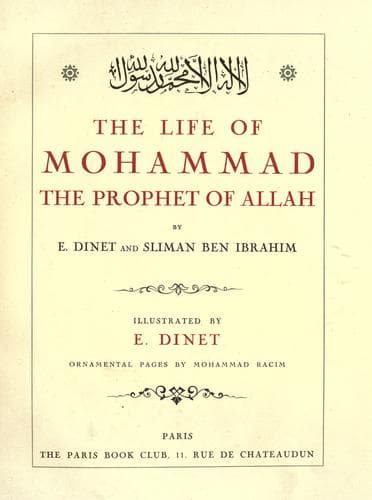
The Life of Mohammad, the Prophet of AllahDinet, Etienne
Religion
The Life of Mohammad, the Prophet of Allah
Dinet, Etienne
Muhammad, Prophet, -632
"The reader may perhaps ask why, under these conditions, the influence
of the Arabs is so unappreciated in our day by learned men who, by
their intellect, seem far above all religious prejudice. That is
because independence of opinion is more apparent than real, and we are
not at all free to think as we like about certain subjects. The
hereditary prejudices professed by us against Islamism and its
disciples have accumulated during too many centuries not to have
become part and parcel of our organism....
"If we join thereto other prejudices also hereditary, and increased in
each generation by our detestable classic education: that all sciences
and literature of the past spring solely from Greeks and Romans, we
can easily understand that the great influence of the Arabs in the
history of European civilisation is generally slighted.
"In certain minds, it will always seem humiliating that it is owing to
the Moslems that Christian Europe shook off barbarism...." (Dr.
Gustave Le Bon, _La Civilisation des Arabes_.)
What caused Islam to fall so rapidly, after having, during the eight
centuries of its domination in Spain, placed that country not only at
the head of occidental civilisation, but also causing it to shine
quite as brilliantly from Delhi and Bokhara, as far as Constantinople
and Fez?
The first cause may be found in the non-observance of the strictly
levelling principles that the Prophet had so much trouble to establish
while he lived, and which were the motives of his successes and of
those of the first Caliphs. One example will serve to show how
rigorously these principles were applied in the beginning: "A rich,
powerful, and proud monarch, Jabala, newly converted, struck violent
blows in the face of a poor Bedouin, who had accidentally pushed
against him while he was performing his devotions round the Ka'bah.
Without bringing into account the rank of the delinquent, or the
danger of estranging such an important personage, the Caliph Umar
thought that, for the honour of the future of Islam, equality in the
eyes of law and justice should override all other considerations, and
he condemned King Jabala to undergo, at the hands of the humble
Bedouin, the same chastisement as had been inflicted on him."
With such strict principles, no one could possibly be proud of
anything but his personal merit; and emulation gave birth to miracles
for the greater good of Islam. No men were chosen as chieftains except
those who deserved that honour, and once elected, they were blindly
obeyed because they were sincerely admired and respected.
Public-domain text, read in full here on John Shaqi.
Reviews
Reviews
No reviews yet
Be the first to share your thoughts on this work.
Elsewhere in the archive
Join the Discussion
Join the discussion
Sign in to leave a comment or review.
Sign InorCreate an account