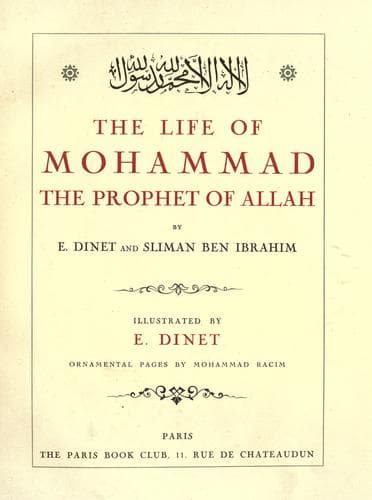
The Life of Mohammad, the Prophet of AllahDinet, Etienne
Religion
The Life of Mohammad, the Prophet of Allah
Dinet, Etienne
Muhammad, Prophet, -632
Unfortunately, the complete observance of this master-thought of the
Prophet turned out to be ephemeral, and already under the rule of
Usman, the third Caliph, aristocratic prejudices began to regain their
evil influence. In vain Mohammad had said to his beloved daughter,
Fatimah-tuz-Zahra: 'Work, and reckon not that it sufficeth for thee to
be the Prophet's daughter;' the sons of most unimportant people
despised their Mussulman brothers of more lowly origin, and thought
that their social rank exempted them from making those efforts without
which no progress can be realised. Moreover, rivalry between folks
more proud of their forbears than of their own works, gave rise again
to fractricidal struggles, as ruthless as in the past; and with them,
the disorganisation and general anarchy which had paralysed the Arabs
of pre-Islamic times. Having lost all taste for study; separated and
exhausted by incessant civil wars, the Moslems were only able to offer
puny resistance to the Christians, who dreamt of revenge and had
profited by these dissensions to organise themselves.
In the past as in the present, Islam might have avoided the greater
part of its misfortunes if it always remembered this last adjuration
of the Prophet in his sermon of the Valedictory Pilgrimage: 'Never
forget that each Mussulman should be a true brother to every other
Mussulman!'
The second cause of its decline arose from one of the primordial
qualities of Islam. The conformity of its dogma, almost entirely
devoid of supernaturalism, to the exigencies of reason, was at first
inestimably advantageous for science which remained free from the
hindrances of superstition. This suffices to explain the rapid rise of
its civilisation. But the Moslem mind had gradually been lulled, being
satisfied with the magnificent results attained by the enthusiasm
reigning in the first centuries of the Hegira. Henceforth, it
was at the mercy of animal passions and fetishism, in certain
newly-conquered countries. The cult of Saints and Intercessors,
"Awliya," or "Murabitun," borrowed from the Christians and so strictly
forbidden by the Qur'an, took the place of the cult of Science and, by
its gross superstitions, barred all progress. Philosophers like
Averroes, tried to struggle, but it was too late; the evil was too
deeply rooted among the masses who called these enlightened men
ungodly, and demanded that they should be put out of favour....
These two causes of decay are ancient, and contradict the real
doctrine of the Qur'an. On the other hand, there is one, dating from
the nineteenth century only, and which seems to be in accordance, if
not with the spirit, at least with the letter of the Holy Book. It is
that which results from the prohibition of any interest whatsoever
being received for money lent.
Public-domain text, read in full here on John Shaqi.
Reviews
Reviews
No reviews yet
Be the first to share your thoughts on this work.
Elsewhere in the archive
Join the Discussion
Join the discussion
Sign in to leave a comment or review.
Sign InorCreate an account