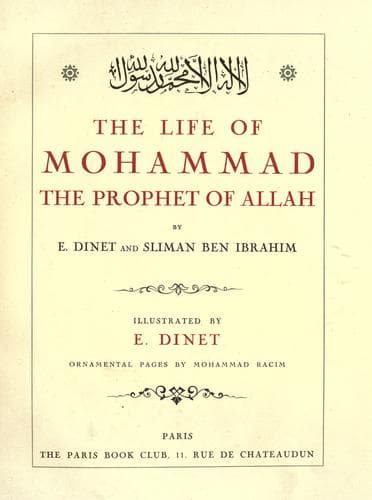
The Life of Mohammad, the Prophet of AllahDinet, Etienne
Religion
The Life of Mohammad, the Prophet of Allah
Dinet, Etienne
Muhammad, Prophet, -632
Is it true that Mussulman women are reduced to such a lamentable
situation? It is certain that in the eyes of European women enjoying
untrammelled freedom, the wearing of a veil and semi-claustration as
well, to which the women of Islam are subjected, must seem to be
tokens of the most unbearable slavery. But if these ladies of Europe
heard the reflexions of these same Mussulman women, objects of
monogamists' wives' heartfelt commiseration, they would be surprised
to learn that they, in their turn, are not envied, but charitably
pitied. Besides, the wearing of the veil and claustration are in no
wise religious obligations. The Verses of the Qur'an (XXXIII, 53, 55)
by which these questions are supported, are solely aimed at the
Prophet's wives and not at those of all Believers, as might be deduced
from the inexact translation of verse 55, by Kasimirski.
These practices, put in force many years after Mohammad's death, are
therefore fiercely attacked by numerous champions of the feminine
cause. Among them, we note Qasim Bey Amin, with his book:
"Tahriru'l-Mirat" ("Woman's Emancipation"); and Es Zahawi, the poet of
Bagdad, who wrote a celebrated letter on the veil, and says: 'Woman is
the remedy of youth, the beauty of nature and the splendour of life.
Without women, man is a sterile syllogism--he does not conclude!' And
then, relying on this verse: "_And it is for the women to act as the
husbands act towards them with all fairness._" (THE QUR'AN, II, 228),
he claims complete female freedom.
We will conclude by quoting the words of one of the fair sex, al-Sitti
Malika who, with the consent of her father, Hifni Bey Nasif, formerly
professor at the University of Al Azhar, published a Qasida,
terminating with this verse: 'To unveil, if one is chaste, is no harm;
and if one is not chaste, veils in excess offer no protection.'
At the same times as European queens of fashion have tried to
acclimatise the Turkish veil in the West, perhaps at some future
period, near or distant, the custom of wearing the veil may die out in
the East. In that case, the flower of Mussulman beauty will have been
stripped of its graceful calyx. Will not the woman of the East regret
the mysterious charm she owed to her filmy mask? Will she be
compensated by the advantages accruing to her in consequence of
budding forth in the strong light of civilisation? The example of the
great misery reigning among her sisters of the West, struggling for
life in opposition to men, may perhaps frighten the woman of the East
when, with dazzled eyes, scarcely awakened from harem dreams, she
plunges into the vortex of modern existence. The question is too
delicate. We dare not come to a conclusion. After all, the interest
and possibility of such reforms vary too completely, from one country
to another, so that no general rule can be fixed.
Public-domain text, read in full here on John Shaqi.
Reviews
Reviews
No reviews yet
Be the first to share your thoughts on this work.
Elsewhere in the archive
Join the Discussion
Join the discussion
Sign in to leave a comment or review.
Sign InorCreate an account