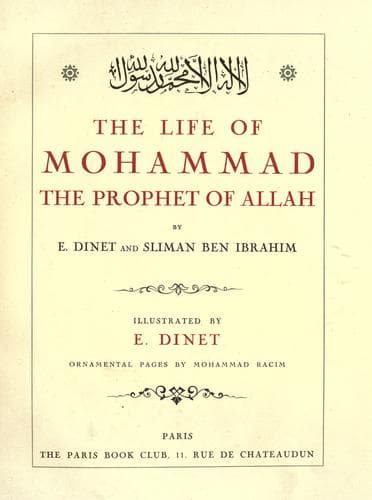
The Life of Mohammad, the Prophet of AllahDinet, Etienne
Religion
The Life of Mohammad, the Prophet of Allah
Dinet, Etienne
Muhammad, Prophet, -632
But if we hesitate about passing judgment on the reforms we have just
set forth, we acknowledge unreservedly, to make amends, that the
education of woman is an imperious necessity for the future of Islam.
Education has nothing to do with the above-mentioned customs. It is in
agreement with all the principles of the religion, and during the
period of Islamic splendour, was lavished on Mussulman femininity
whose culture was superior to that of European women in those days.
In the East, education has never disappeared as completely as in some
regions of the Maghrib. During a certain number of years, many
Mussulman women passed their leisure harem hours in educating
themselves, and their new intellectual birth began to be generalised.
From education alone the evolution of manners and customs will proceed
wherever it will be necessary in the sense and proportions creating
the least amount of trouble in the bosom of families.
[Sidenote: CONCLUSION]
The knots relating to polygamy and the emancipation of woman (the only
questions that give a shadow of right to inimical critics of Islam)
once cut, Islam will appear to be what it really is: a religion
essentially in conformity with the most modern needs and ideas, so
much so that an Englishman, Oswald Wirth, was able to write: 'I
discovered, one fine day, that I was a Mussulman, without knowing it,
like Monsieur Jourdain with his prose.' In like fashion, Goethe, after
having studied the principles of the Qur'an, declared: 'If that is
Islam, do we not all live in Islam?'
Very soon, no one will venture to give credence to the childish
legends perpetuated since the Crusades, and Islam will at last claim
to take its place in the van of modern civilisation....
We were writing the concluding lines when suddenly the most formidable
conflict ever know in history broke out in Europe, and thousands of
Moslem soldiers, descendants of the warriors of Poitiers, immediately
invaded the whole of France.
This time, they came not as conquerors, but as friends; as
brothers-in-arms, summoned by the Allies to take part in this gigantic
struggle on which depends the fate of civilisation. Their traditional
heroism has been admired by all. The French soil is riddled by
thousands of their graves, thereby they have implanted Islam for ever
in the heart of Europe, in the most glorious way; and a strong
contingent of the Prophet's disciples is now in European territory.
After such services rendered, it will be churlish to refuse them the
freedom of the city, so to speak, that we have already claimed on
their behalf. We go further and ask if it is admissible to think that
their example, dealing the last blow at the imputations of the past,
may give some Europeans food for fresh reflexion?
Public-domain text, read in full here on John Shaqi.
Reviews
Reviews
No reviews yet
Be the first to share your thoughts on this work.
Elsewhere in the archive
Join the Discussion
Join the discussion
Sign in to leave a comment or review.
Sign InorCreate an account