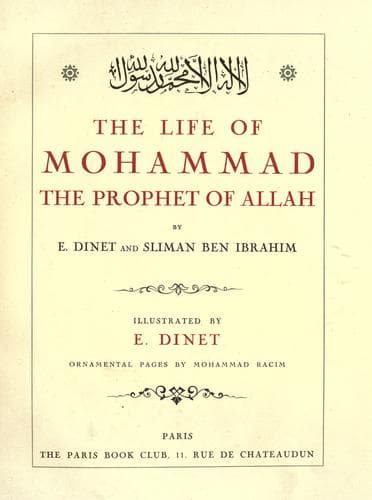
The Life of Mohammad, the Prophet of AllahDinet, Etienne
Religion
The Life of Mohammad, the Prophet of Allah
Dinet, Etienne
Muhammad, Prophet, -632
Undeceived by the failure of integral rationalism, many anxious minds
seek new paths. "The modern system of intuition, towards which they
hurry, following Bergson, its celebrated defender, represents decided
reaction against rationalism, or to be more exact, against the
powerlessness of rationalism....
"In the hearts of men hungering after faith, this eminent thinker has
caused the aspirations they seem to have lost definitively to be born
anew. He allows them to hope for the survival of the soul; he tells
them that this world is not a great mass of machinery driven by blind
forces and that intelligence is not the only formula of our senses....
"In affirming all this, the illustrious philosopher is perhaps
confining himself to the task of reviving ancient illusions; but he
has awakened them so that we may hear; and at a moment when they may
serve to prepare the elements of a new religion, needed by many men."
(_La Vie des Vérités_, by Dr. Gustave Le Bon.)
Such a movement is irresistible, especially after the sanguinary
ordeals we have undergone. We are therefore about to witness the
efforts of new and old religions, trying to monopolize these
manifestations and turn them to account. Rationalism, however,
although defeated, has nevertheless been fruitful, and it will oppose
an insuperable barrier to the dogmas that run counter to reason much
too violently.
On the other hand, must not mystic, pathetic and poetical aspirations
be reckoned with? Are they not the essential final causes of all
religions? To sum up, are not the most needful conditions of a modern
religion those of advanced Protestantism: "Unitarism," clothed in a
glorious cloak of poetry?
Islam, freed from all the dross which it accumulated in its course,
has precisely these conditions, and already small communities of
European converts to Islam have been founded in England and America.
One of them, having Mr. Quilliam at his head, exists for several years
past at Liverpool, and is remarkable for the fact that the majority of
its proselytes belong to the weaker sex.
The conversion of Lord Headley, an English peer, followed by that of
other well-known leading Londoners, created a great sensation. The
Mussulman commonwealth, founded by this eminent man, publishes a
monthly magazine, "The Islamic Review," from which we take the
following significant passage:
"Why have Englishmen and other Europeans become Mussulmans? In the
first place, because they sought for some simple, logical, essentially
practical creed; (for we English flatter ourselves that we are the
most practical people under the sun) a creed fitting in with the
conditions, customs, and occupations of every people; a divine, true
creed, where the Creator and Man are face to face, without any
intermediary." (Sheldrake.)
Public-domain text, read in full here on John Shaqi.
Reviews
Reviews
No reviews yet
Be the first to share your thoughts on this work.
Elsewhere in the archive
Join the Discussion
Join the discussion
Sign in to leave a comment or review.
Sign InorCreate an account