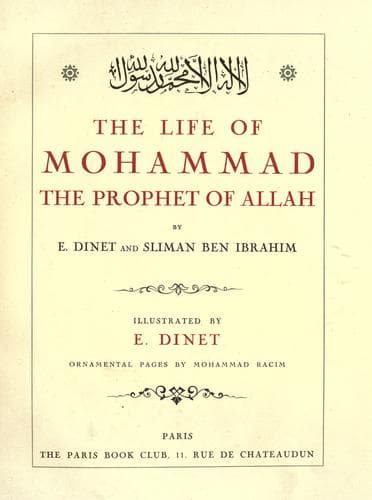
The Life of Mohammad, the Prophet of Allah — John Shaqi
The Life of Mohammad, the Prophet of AllahDinet, Etienne
Religion
The Life of Mohammad, the Prophet of Allah
Dinet, Etienne
Muhammad, Prophet, -632
He who had fled from his fellows and had never aspired to fill any
post of public utility, such as his citizen-comrades would have been
glad to grant, was ready now, with resolute faith and courage, to
fulfil the most overwhelming mission that can be confided to a human
being, and he cared not a jot for the terrible ordeals that he knew
were inevitable.
During that night, for ever memorable, known by the name of
"Leilat-al-Qada," or "Night of Destiny," the Qur'an came down in its
entirety from the highest Heaven where it was kept, as far as the
inferior Heaven, situated immediately above the earth. And there it
had been deposited in the "Bait-al-Izza," or "House of Glory,"
underneath which was erected the "Baitu'l-Lah," or "House of Allah,"
which signifies the Holy Ka'bah.
"_Verily, we have caused It (the Qur'an) to descend on the night of
Power * And what shall teach thee what the Night of Power is? * The
Night of Power is better than a thousand months! * Therein descend the
angels and the Spirit by permission of their Lord for every matter. *
All is peace until the breaking of the morn._" (THE QUR'AN, XCVII,
1-5.)
Then, from this lower Heaven, after the first verses are revealed to
Mohammad, together with a general comprehension of his Mission, the
words of Allah, comprising the Qur'an, come down now from between his
lips, Surah following Surah, for a period of twenty-three years, so as
to guide all his actions, establish the laws of religion and organise
the triumph of Islam.
For the benefit of our European readers, we consider it needful to add
the following commentary to this story of the Revelation, according to
Arab historians:
The angel Jibra'il, who sought out the Prophet at Hira is none other
than the angel Gabriel who appeared to Daniel; and to Mary, the mother
of Jesus; but real Moslems say that Jibra'il is totally unlike the
pink-cheeked, fair-haired youth, with wings of varied hues, as seen in
the cheap, religious, saintly images of the Europeans. The angel
Jibra'il is "ar-Ruh," the "Pure Spirit," (THE QUR'AN, XCVII, 6); and
also "An Namus," or "The Invisible Adviser." Sometimes he manifested
his presence to Mohammad by stray sounds resembling tinkling bells or
the hum of bees, by which he caused Allah's Messenger to suffer more
than anything. His brow would be bathed in sweat, even during cold
wintry days, and it was only when the noise died away that he
understood what the angel had revealed to him. At other times, when
Jibra'il taught Mohammad ritual movements, the angel made his presence
manifest by assuming the appearance of a mortal resembling Dihyah ibn
Khalifah, one of the Prophet's companions.
The Revelation, of which this angel is the symbolic intermediary, is a
divine Irradiation and should be looked upon as the highest degree of
the mysterious Force, evidently surrounding mortals, since it is
totally independent of a man's will-power, and which we call
Inspiration.
[Sidenote: THE FIRST MOSLEMS.]
Public-domain text, read in full here on John Shaqi.
Reviews
Reviews
No reviews yet
Be the first to share your thoughts on this work.
Join the Discussion
Join the discussion
Sign in to leave a comment or review.
Sign InorCreate an account