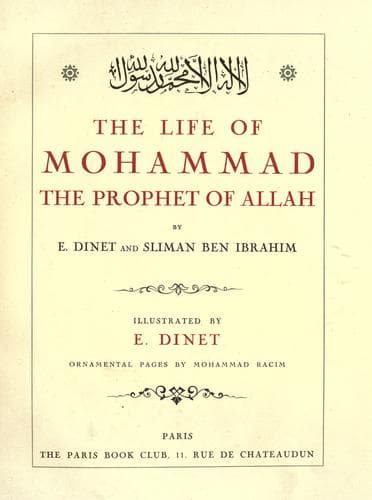
The Life of Mohammad, the Prophet of AllahDinet, Etienne
Religion
The Life of Mohammad, the Prophet of Allah
Dinet, Etienne
Muhammad, Prophet, -632
Therefore the Believers, their faith revived, hastened to put on the
five "Garments of Purity," which means that they offered up the five
prayers brought down to them from Heaven by the Prophet.
[Sidenote: HOW SIX INHABITANTS OF YASRIB WERE CONVERTED (_A.D. 620_)]
Towards the end of the year, Usman ibn Affan and his wife Ruqaiyah
returned from Abyssinia, accompanied by a few emigrants, among whom,
one of them, called Sukran, died on arrival. The Prophet married his
widow, Sauda, daughter of Zoma, thus rewarding the zeal of one of the
first female converts to Islam, who had so valiantly undergone the
ordeals of persecution and exile.
Wishing, in the same way, to show his appreciation of the unchanging
devotion of Abu Bakr, the Veracious, and to bind him still closer by a
matrimonial alliance, the Prophet, at the same epoch, espoused his
daughter Ayishah, although she had barely reached the age of ten. But,
in her case, the marriage was not consummated until many years later,
at Al-Madinah, after the Hegira.
Despite Abu Bakr's energetic affirmations; despite the strengthening
of the Believers' zeal by the rule of the five prayers, the story of
the Nocturnal Ascension was far from being advantageous to the cause
of Islam. The narrative, on the contrary, furnished its enemies with
an opportunity of petty triumph, enabling them to pile up fresh
mockery and institute greater persecution.
The case would have seemed hopeless to any other but Mohammad. He knew
not what it meant to be discouraged, feeling certain that the Almighty
would never abandon His Apostle to whom He had revealed the following
verses: "_Say: I betake me for refuge to the Lord of Men, * The King
of Men, * Allah of Men * Against the mischief of the stealthily
withdrawing whisperer (Satan) * Who hides himself at the Name of
Allah, * Who whispereth in man's breast against Jinn and men._" (THE
QUR'AN, CXIV, 16.)
Postponing for the time being the conversion of the Makkans, the
Prophet turned his attention towards Arab strangers in the town,
attracted in great crowds by the ceremonies of the pilgrimage to the
Ka'bah and the ritual circuits. During the fair that was held at that
time, he went untiringly from group to group. But, just as
indefatigable, close behind, was his uncle, Abu Lahab, who, as soon as
he saw the Prophet in the centre of a ring of men, would call out
loudly to them: 'Hearken not to that man! His sole thought is to tear
the cult of Lat and Uzza from out of your hearts; and trick ye all
with the insane doctrines that he pretends it is his Mission to
preach.'
These words aroused the Arabs' suspicions, and they turned away from
Mohammad with remarks after this fashion: 'Thy fellow-citizens know
thee better than we, so begin by convincing them!' Or else: 'If Allah
should cause thee to triumph, thy glory will not profit us, but only
thy party. Therefore, it is not to our advantage to ally ourselves to
thee.'
Public-domain text, read in full here on John Shaqi.
Reviews
Reviews
No reviews yet
Be the first to share your thoughts on this work.
Elsewhere in the archive
Join the Discussion
Join the discussion
Sign in to leave a comment or review.
Sign InorCreate an account