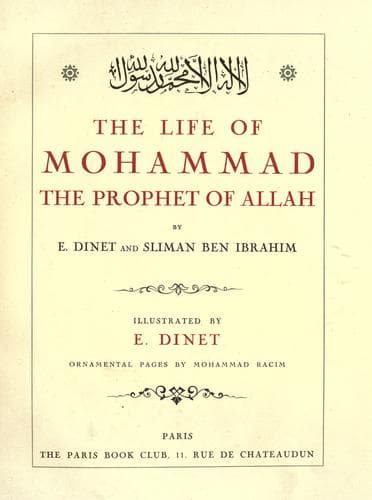
The Life of Mohammad, the Prophet of AllahDinet, Etienne
Religion
The Life of Mohammad, the Prophet of Allah
Dinet, Etienne
Muhammad, Prophet, -632
According to the Arab tradition, it was built by Adam, the father of
the human race. Destroyed by the Flood, it was rebuilt on the same
foundations, by the Prophet Abraham, with the help of his son,
Ishmael, the ancestor of the Arabs. Since then, often repaired, but
retaining the same lines and proportions, the Ka'bah became the goal
of Arab pilgrims flocking to adore Allah, the Only One, and perform
seven ritual circuits instituted by their forefathers under the title
of "Tawaf."
Little by little, the worship of Allah, the Only One, having
degenerated in the memory of the pilgrims who added the practice of
idolatry, Mohammad was sent to destroy the three hundred and sixty
images they adored.
In the east angle of the monument is incrusted the famous black stone
"Hajaru'l-Aswad", framed in a silver circle.
This stone, which came down from Paradise, was brought by the angel
Jibra'il (Gabriel) to Abraham and his son, during the rebuilding of
the Temple, and they placed it where it is still to be seen this day,
in order to serve pilgrims as a starting-point for their ritual
circuits. Primitively as white as milk, its present characteristic
ebony tint is due to the pollution of the sins of the pilgrims who
came to touch and kiss it, while imploring the Merciful to pardon
them.
Close to the Ka'bah is the well of Zamzam. Its miraculous water gushed
forth from the earth to save Ishmael from the tortures of thirst when
lost in the desert with his mother, Hajar (Hagar). Neglected by the
Arab tribes, in the dark Days of Ignorance, it became choked up by
sand and was dug anew by Abdul Muttalib, a few years before the birth
of Mohammad. The water, ever since, is revered by pilgrims who use it
for drinking purposes and for their ablutions, thereby sanctifying
themselves by the remembrance of their ancestors.
The two functions of "Siqayah," (Management of Water Supply), and of
"Hajaba," (Superintendence of the Ka'bah) were posts greatly sought
after on account of their prerogatives. At the epoch at which our
story begins, they were both united in the hands of Abdul Muttalib bin
Hashem, of the Quraish tribe, the grandfather of the future Prophet.
[Sidenote: THE MARRIAGE OF ABDULLAH, FATHER OF THE PROPHET]
One day, Abdul Muttalib, custodian of the Ka'bah, set forth from the
Sanctuary, his favourite son, Abdullah, holding his hand.
Public-domain text, read in full here on John Shaqi.
Reviews
Reviews
No reviews yet
Be the first to share your thoughts on this work.
Join the Discussion
Join the discussion
Sign in to leave a comment or review.
Sign InorCreate an account