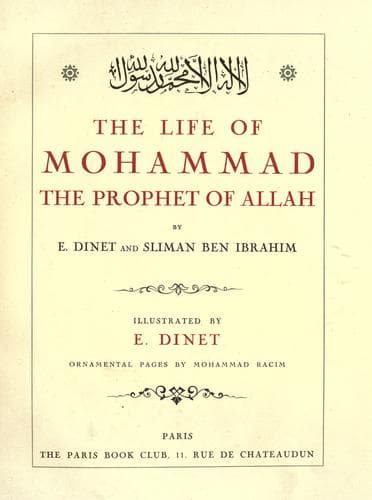
The Life of Mohammad, the Prophet of AllahDinet, Etienne
Religion
The Life of Mohammad, the Prophet of Allah
Dinet, Etienne
Muhammad, Prophet, -632
So then Mohammad alighted, saying: 'Allah causeth me to set foot on
the ground in a blessed spot. Here will be the finest place in which
to dwell.' This piece of property was a "marbad," _i.e._ a barn-floor,
where dates were laid out to dry. It was situated in the district of
the Banu Nijar, not far from the house of Abu Ayyub Ansari who offered
hospitality to the Prophet, and took his saddle and saddle-bags to his
dwelling. Whilst the Apostle, momentarily freed from the veneration of
the populace, was settling under that friendly roof, young people and
slaves dispersed in all directions, singing: 'Mohammad hath come! The
Prophet of Allah hath come to our town!'
Ever since that day, eternally memorable, the city of Yasrib was
called, "Madinatu'n-Nabi," the City of the Prophet; and by
abbreviation, "Al-Madinah." (Medinah).
[Sidenote: HOW THE MOSQUE OF AL-MADINAH WAS BUILT]
At Al-Madinah, Mohammad's first care was to erect a Mosque.
He sought for the owners of the ground where his she-camel had knelt,
and they turned out to be two orphans, named Sahil and Sohail, whose
guardian was Muaz ibn Afra. The Prophet asked them how much they
wanted for their piece of property. 'Allah's reward is the only price
we ask,' was their reply. Mohammad, however, refused the gift. The
purchase-money, fixed at ten dinars, was advanced by Abu Bakr, who had
transferred all his wealth from Makkah to Al-Madinah.
Acting under the Prophet's orders, the Believers lost no time in
getting to work. They cleared up the "Marbad," where there were
ruined walls, a palm-tree and a few neglected tombs. They levelled the
ground and, as soon as the foundations were dug, Mohammad lifted a big
stone to place in the cavity, and his noble breast became covered in
dust. Seeing this, his companions tried to prevent him from doing
manual labour; but he said to Abu Bakr: 'Say no more, but follow my
example. Put a stone next to mine.' He then commanded Umar to place
another at the side of the one set down by Abu Bakr; and each of the
leading Moslems contributed in succession his stone to the structure.
When the stone foundations reached up to a third of the eventual
height of the walls, the Believers began to knead clay with water,
making unbaked bricks, with which they intended to finish the
building. The Prophet, as before, continued to encourage his followers
by his example, and he carried bricks in his mantle. Seeing one of the
workers with a double load on his back, Mohammad wiped his disciple's
hair and neck, soiled with clay, and said: 'The reward of the labourer
awaits him in heaven, but thou wilt find a double reward.'
Public-domain text, read in full here on John Shaqi.
Reviews
Reviews
No reviews yet
Be the first to share your thoughts on this work.
Elsewhere in the archive
Join the Discussion
Join the discussion
Sign in to leave a comment or review.
Sign InorCreate an account