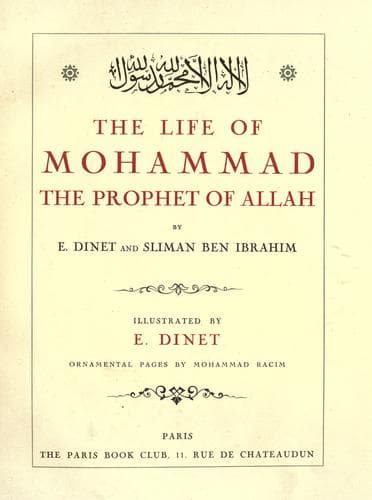
The Life of Mohammad, the Prophet of AllahDinet, Etienne
Religion
The Life of Mohammad, the Prophet of Allah
Dinet, Etienne
Muhammad, Prophet, -632
All the Believers toiled in high spirits, and to quicken their task by
working in measure, the masons sang in chorus, and the verses of their
chants related to their exalted hopes. When the walls were seven
cubits high, the Faithful covered the building with a flat roof, made
of palm-tree trunks, thatched with lathes and palm-leaves. On this,
they spread a layer of beaten earth, thick enough to prevent rain
filtering through. The ceiling was supported inside by columns of
date-tree trunks, and the floor was sprinkled with gravel.
The building was one hundred cubits in length; its breadth being a
little less. It could be entered by three doors; of which the
principal was called "Bab-ur-Rahma," or "Door of Mercy." The "Mimbar,"
or pulpit, was fashioned out of a simple palm-tree trunk on which the
Prophet mounted when he preached his sermons.
It can thus be seen that this first Mosque, identical with those of
the poorest villages of the Sahara, was far from resembling the
marvellous edifices which were to be constructed a little later for
the Islamic religion.
At the same time as the Mosque was being finished, Mohammad had caused
two little hovels to be built with clods of earth--"Hujrah"--leaning
against the walls of the temple. The Prophet proposed to live there
with his family and he sent Zayd, his adopted son, to Makkah to fetch
them. When the houses were finished, he left the dwelling of Abu Ayyub
and settled down with his people who lost no time in arriving.
As for the Muhajirun, they had all been generously and hospitably
welcomed by the Ansars, proud and joyful to receive beneath their
roof-trees those of the strangers who fell to them by lot.
Mohammad was especially moved by the cordial welcome extended to his
fellow-countrymen by his new disciples. But, with his great insight
concerning the souls of mortals, he resolved to tighten the bonds of
such touching friendship. So that it should be proof against all
insinuations dictated by the rivalry, inevitable in the future,
between the Muhajirun who had forsaken their country, families and
wealth to follow him; and the Ansars who had offered the safe shelter
and material assistance to which his triumph was due. Would not each
party have some little reason to claim for it alone first rank in the
Prophet's affection and the annals of Islam?
In order to avoid such dangerous contingencies and create real family
ties for the exiles, Mohammad profited by the cloudless exaltation
uniting Muhajirun and Ansars just then, to issue a decree of perfect
brotherhood between them. He ordained that they should pair off in
couples consisting of a man of the Mohajirun and an Ansar. 'Fraternise
in Allah!' he told them. 'Ye are brothers!' Henceforward, every
Mussulman of Al-Madinah had for brother a Mussulman of Makkah.
Public-domain text, read in full here on John Shaqi.
Reviews
Reviews
No reviews yet
Be the first to share your thoughts on this work.
Elsewhere in the archive
Join the Discussion
Join the discussion
Sign in to leave a comment or review.
Sign InorCreate an account