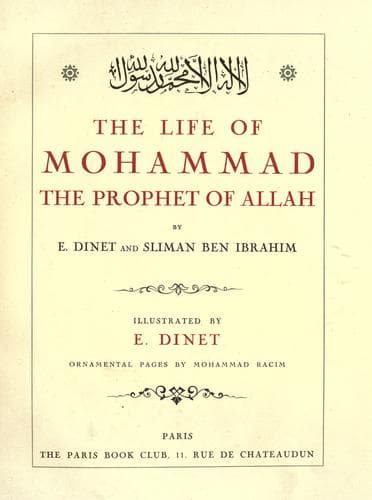
The Life of Mohammad, the Prophet of AllahDinet, Etienne
Religion
The Life of Mohammad, the Prophet of Allah
Dinet, Etienne
Muhammad, Prophet, -632
Prayer in common is incontestably the most profitable; the fervour of
each Believer communicating with the soul of his neighbour. "It is
worth twenty-seven times more than isolated prayer," says the Prophet.
It was therefore necessary to summon all Believers together every day,
at the same hours fixed for the five prayers.
How was the exact time of meeting to be determined? Scattered over the
different districts of the city, some came too early; others too late.
A consultation of the leading Moslems took place. Some were for the
use of a beacon, to be lit on a commanding eminence; others suggested
the blowing of a horn; and the rest proposed bell-ringing. But all
these methods were rejected, because they were borrowed, from
Persians, Jews or Christians.
[Illustration: _The Mu'azzin's Call._]
Meanwhile, Abdullah ibn Zayd arrived, and he told of a dream he had
had the night before. A man attired all in green passed close to me,
carrying a hand-bell. I stopped him and begged him to sell me his
bell. 'What dost thou want it for?'--'To summon Believers to
prayer.'--'A much better way,' he replied, 'would be to proclaim the
profession of faith of Islam with all the strength of thy lungs.'
The Prophet, alive to the fact that the resonance of the human voice
is more capable of communicating emotion than the most perfect metal
instrument of music, declared at once: 'In thy dream was truth. Go and
find Bilal. His voice is powerful and harmonious. I charge thee to
order him to mount to the roof of the Mosque and summon the Believers
to prayers.' So Bilal, the freed negro, told to call all the Believers
together, of all ranks and races, uttered from the terrace of the
Mosque the cry of the Islamic soul: "_Allah is great! There is no God
but Allah, and Mohammad is the Prophet of Allah! Come to prayer! Come
to Salvation!_"
Like exquisite perfume wafted from a priceless flask, these words in
the melodious voice of Bilal and issuing from his strong lungs,
resounded through the city. Echoing in all dwellings, they caused
every citizen to inhale with delight the refreshing scent of prayer.
Ever since, in every Mosque all the world over, it is the duty of a
crier, called a "muazzin," to give this summons to prayer five times
daily which he does from the top of a slender minaret erected for that
purpose.
[Sidenote: THE FAST OF RAMADHAN]
After having decided that the human voice should be used for the call
to prayer, Mohammad, when first he dwelt in Al-Madinah, continued to
set forth the formal obligations of the Islamic religion.
Public-domain text, read in full here on John Shaqi.
Reviews
Reviews
No reviews yet
Be the first to share your thoughts on this work.
Elsewhere in the archive
Join the Discussion
Join the discussion
Sign in to leave a comment or review.
Sign InorCreate an account