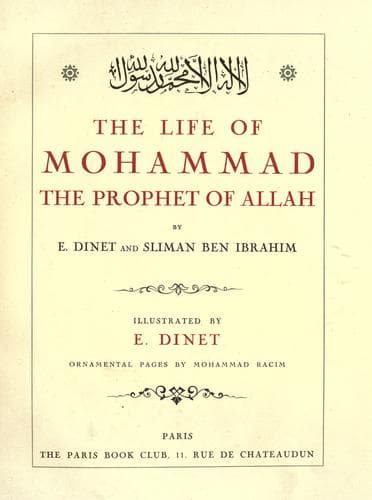
The Life of Mohammad, the Prophet of AllahDinet, Etienne
Religion
The Life of Mohammad, the Prophet of Allah
Dinet, Etienne
Muhammad, Prophet, -632
It would be sheer madness to try and find words to express the degree
of devotion attained by this brotherhood of religion, stronger than
ties of blood, for it was supernatural. All these men's hearts, united
in the love of Allah, were now nothing more than a single heart,
palpitating in different breasts. Each man loved his brother better
than himself, and during the first years of the Hegira, when one died,
the other inherited his property, to the exclusion of his natural
heirs.
Among the fraternal unions thus constituted, we may note those of Abu
Bakr with Kharijah ibn Zayd; Ummar with Usman ibn Malik; Abu Ubaidah
with Sad ibn Muaz; and Usman ibn Affan with Aus ibn Najar. The prophet
had been the first to choose Ali for his brother, thus sealing the
bond of fraternity that he had signed when beginning his mission. But
as Ali belonged to the Muhajirun, the Ansars might have been vexed
because the Apostle did not choose a brother in their ranks. That was
why, at the death of one of their Najibs, Asad ibn Zararah, Mohammad
took his place as Najib, pretexting that he was one of them, because
his uncle on his mother's side had formerly dwelt in their city.
In this way, thanks to his sense of psychology and diplomatic skill,
Mohammad achieved a wonderful result: the wars between the Kajraz and
the Aus which, for centuries past, had deluged Yasrib with blood,
ceased as by magic, soon after his arrival. He metamorphosed the
inhabitants of Al-Madinah into the brothers of the Makkan emigrants,
formerly their rivals.
[Sidenote: THE QUIBLAH OF MAKKAH]
In the beginning, the Prophet allowed the Believers full liberty to
turn in any direction they pleased when saying their prayers, for:
"_The East and the West is Allah's; therefore, whichever way ye turn,
there is the face of Allah. Truly Allah is Omnipresent, Omniscient._"
(THE QUR'AN, II, 109).
While terminating the building of the first Mosque, the Prophet
divined that prayerful impulsiveness diverted in one direction would
be more thrilling, because of the feeling of union in the same ideals
that was bound to result. By means of a cube of masonry, composed of
stone and clay placed against the wall of the building looking south,
he primitively established the Qiblah, or direction of prayer, towards
the Temple of Jerusalem.
But he was ordered by a verse to change the direction towards Makkah:
"_We have formerly seen thee turning thy face towards every part of
the Heaven; but We will assuredly have thee turn to a Qiblah which
shall please thee. Turn then thy face towards the Sacred Mosque, and
wherever ye be, turn your faces in that direction._" (THE QUR'AN, II,
139).
And ever since that day, the Qiblah remains definitively fixed for all
the Mussulmans of the world, in the direction of the Temple of Makkah.
[Sidenote: INSTITUTION OF THE AZAN, OR CALL OF THE MU'AZZIN]
Public-domain text, read in full here on John Shaqi.
Reviews
Reviews
No reviews yet
Be the first to share your thoughts on this work.
Elsewhere in the archive
Join the Discussion
Join the discussion
Sign in to leave a comment or review.
Sign InorCreate an account