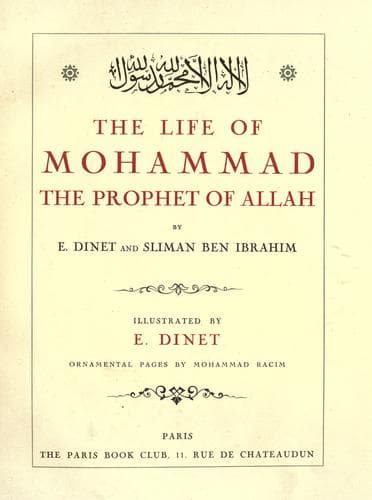
The Life of Mohammad, the Prophet of AllahDinet, Etienne
Religion
The Life of Mohammad, the Prophet of Allah
Dinet, Etienne
Muhammad, Prophet, -632
Thus began the long series of campaigns called "Ghazwah" when the
Prophet was personally in command; and "Saria," when one of his
lieutenants led the van. We shall only mention the most characteristic
of these innumerable expeditions; putting on one side the first minor
skirmishes and come at once to the famous Ghazwah of Badr.
[Sidenote: THE GHAZWAH OF BADR (_Year of the Hegira, A.D. 624_)]
A caravan of exceptional importance, comprising a thousand camels, had
been sent into Syria by the citizens of Makkah. It was to bring back
the most valuable and highly-prized merchandise. This was the
opportunity awaited by the Prophet. If he succeeded in capturing the
caravan, he would deal a ruinous blow at those who banished him and,
as he hoped, without useless bloodshed, for the escort of the convoy
numbered at most two score. These men could oppose no real resistance
and would be obliged to surrender without fighting.
The Prophet arrived too late. The caravan had gone past. He made up
his mind to fall upon it by surprise during its return journey. One of
his partisans, posted by him to watch the roads, brought the news that
the caravan had been seen, and would soon be near Al-Madinah,
following the usual route, between the mountains and the sea.
Thereupon, the Prophet summoned all the Believers, of any origin
whatsoever. The call was answered by more than three hundred men, all
desirous of inflicting exemplary punishment on the idolaters.
Seventy-three Mohadjirun joined the ranks and, for the first time, two
hundred and forty Ansars stood shoulder to shoulder with their
brothers in Islam. Seventy camels were gathered together to carry
water and food; and also to relieve men on foot who took it in turns
to ride.
The expedition was poor in cavalry, possessing only four horses whose
names were Beraja, Al-Bahrmi, Yasum and Sail. They were led riderless
by the bridle, only to be used at some propitious moment during the
battle. The "Liwa," or white banner, was confided to Musab-al-Abdri,
and the flag of the Ansars was carried by Sad ibn Muaz.
Unfortunately, the organisation of such a numerous "qawm" could not be
kept secret. The "Hypocrites" and the Banu Israil, watching every step
taken by Mohammad, found out what he was preparing and also his
destination. They send messengers to Abu Sufyan, the leader of the
caravan, to inform him of the threatening danger. He sent an Arab of
the Ghifar tribe, named Dhamdham, to beg for assistance and promised
him a rich reward if, thanks to his diligence, the convoy could be
saved.
All the inhabitants of Makkah had contributed, more or less, to the
organisation of the great caravan; and, counting upon its approaching
return, they were already revelling in the fine profits that would
accrue to them. All day long, in groups, they wended their way to the
city gates, gazing, till their eyes ached, into the depths of the
valley following the road to Syria, hoping to catch sight of a
messenger.
Public-domain text, read in full here on John Shaqi.
Reviews
Reviews
No reviews yet
Be the first to share your thoughts on this work.
Elsewhere in the archive
Join the Discussion
Join the discussion
Sign in to leave a comment or review.
Sign InorCreate an account