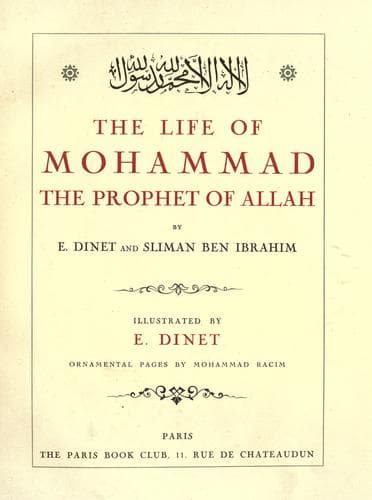
The Life of Mohammad, the Prophet of AllahDinet, Etienne
Religion
The Life of Mohammad, the Prophet of Allah
Dinet, Etienne
Muhammad, Prophet, -632
The Prophet began to feel the urgency of taking up arms for the
triumph of the faith, which could not be definitive until after the
conquest of Makkah where stood the Holy Temple of the Arabs. He had
received the Revelation of the warlike undertaking with orders to
unsheath the sword in his struggle against idolaters: "_And fight for
the cause of Allah against those who fight against you: but commit not
the injustice of attacking them first: verily Allah loveth not the
unjust: * And kill them wherever ye shall find them, and eject them
from whatever place they have ejected you..._" (THE QUR'AN, II, 186,
187.)
Such were the ordinances of "Al-Jahad," "the Holy War" so violently
criticised by Christians.
But did not Jesus--their Lord and ours--Himself declare: "Think not
that I am come to send peace on earth: I come not to send peace, but a
sword." (ST. MATTHEW, X, 34.) "I am come to send fire on the earth;
and what will I, if it be already kindled?" (ST. LUKE, XII, 49.)
If the institution of the "Jahad," destined for the triumph of truth
over idolatry, stirred up strife among the families of Mohammad's
fellow-countrymen for a few years, did not the words of Jesus, still
more imperative in this connection, lead to much more terrible
consequences; lasting too, for centuries among all Christian nations?
"For I am come to set a man at variance against his father, and the
daughter against her mother, and the daughter-in-law against her
mother-in-law." (ST. MATTHEW, X, 35.) "If any man come to me, and hate
not his father, and mother, and wife, and children, and brethren, and
sisters, yea, and his own life also, he cannot be my disciple." (ST.
LUKE, XIV, 26.)
The "Jahad" was not instituted to attack the adversaries of religion
only; it was also proclaimed against those enemies, no less
perfidious, that lurk in every man's own heart. Quoth the Prophet:
"The most meritorious Holy war is that which one declares against
one's own "passions.""
Mohammad and the Believers had been patient quite long enough.
Banished from the land of their birth after having endured pitiless
persecution, did they not have the right, relying on the Revealed
Verses, to resort to the force of arms? The site of Al-Madinah ensured
victory, for that city overlooked all the caravan routes to Syria, of
which the commerce formed the sole resource of Makkah, surrounded by
barren wastes. By stopping these caravans, the Prophet could starve
out the ungrateful town and force its citizens to beg for mercy. In
this way, the Apostle would not be compelled to kill too many of his
fellow-countrymen, whom he still loved despite their iniquity. He
wanted to spare them, hoping to win them over and induce them to
become steadfast supporters of religion.
Public-domain text, read in full here on John Shaqi.
Reviews
Reviews
No reviews yet
Be the first to share your thoughts on this work.
Elsewhere in the archive
Join the Discussion
Join the discussion
Sign in to leave a comment or review.
Sign InorCreate an account