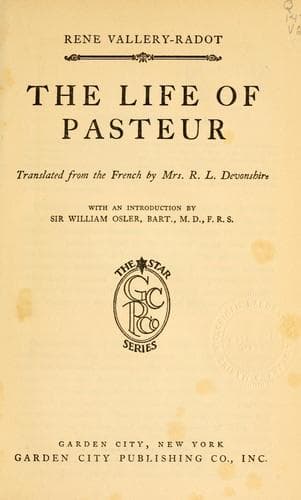
Pasteur, Louis, 1822-1895; Scientists -- France -- Biography
“I have derived from them so great a satisfaction, and my admiration for
his talent has been confirmed and increased to such an extent that I
cannot resist the somewhat rash desire of communicating my
impressions....”
Amongst Claude Bernard’s discoveries, Pasteur chose that which seemed to
him most instructive, and which Claude Bernard himself appreciated most:
“When M. Bernard became in 1854 a candidate for the Académie des
Sciences, his discovery of the glycogenic functions of the liver was
neither the first nor the last among those which had already placed him
so high in the estimation of men of science; yet it was by that one that
he headed his list of the claims which could recommend him to the
suffrages of the illustrious body. That preference on the part of the
master decides me in mine.”
Claude Bernard had begun by meditating deeply on the disease known as
diabetes and which is characterized, as everybody knows, by a
superabundance of sugar in the whole of the organism, the urine often
being laden with it. But how is it, wondered Claude Bernard, that the
quantity of sugar expelled by a diabetic patient can so far surpass that
with which he is provided by the starchy or sugary substances which form
part of his food? How is it that the presence of sugary matter in the
blood and its expulsion through urine are never completely arrested,
even when all sugary or starchy alimentation is suppressed? Are there in
the human organism sugar-producing phenomena unknown to chemists and
physiologists? All the notions of science were contrary to that mode of
thinking; it was affirmed that the vegetable kingdom only could produce
sugar, and it seemed an insane hypothesis to suppose that the animal
organism could fabricate any. Claude Bernard dwelt upon it however, his
principle in experimentation being this: “When you meet with a fact
opposed to a prevailing theory, you should adhere to the fact and
abandon the theory, even when the latter is supported by great
authorities and generally adopted.”
This is what he imagined, summed up in a few words by Pasteur--
Public-domain text, read in full here on John Shaqi.
Reviews
Reviews
No reviews yet
Be the first to share your thoughts on this work.
Elsewhere in the archive
Join the Discussion
Join the discussion
Sign in to leave a comment or review.
Sign InorCreate an account