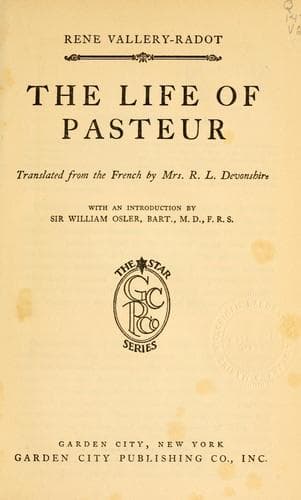
Pasteur, Louis, 1822-1895; Scientists -- France -- Biography
“Meat is an aliment which cannot develop sugar by the digestive process
known to us. Now M. Bernard having fed some carnivorous animals during a
certain time exclusively with meat, he assured himself, with his precise
knowledge of the most perfect means of investigation offered him by
chemistry, that the blood which enters the liver by the portal vein and
pours into it the nutritive substances prepared and rendered soluble by
digestion is absolutely devoid of sugar; whilst the blood which issues
from the liver by the hepatic veins is always abundantly provided with
it.... M. Claude Bernard has also thrown full light on the close
connection which exists between the secretion of sugar in the liver and
the influence of the nervous system. He has demonstrated, with a rare
sagacity, that by acting on some determined portion of that system it
was possible to suppress or exaggerate at will the production of sugar.
He has done more still; he has discovered within the liver the existence
of an absolutely new substance which is the natural source whence this
organ draws the sugar that it produces.”
Pasteur, starting from this discovery of Claude Bernard’s, spoke of the
growing close connection between medicine and physiology. Then, with his
constant anxiety to incite students to enthusiasm, he recommended them
to read the lectures delivered by Bernard at the Collège de France.
Speaking of the _Introduction to the Study of Experimental Medicine_,
Pasteur wrote: “A long commentary would be necessary to present this
splendid work to the reader; it is a monument raised to honour the
method which has constituted Physical and Chemical Science since Galileo
and Newton, and which M. Bernard is trying to introduce into physiology
and pathology. Nothing so complete, so profound, so luminous has ever
been written on the true principles of the difficult art of
experimentation.... This book will exert an immense influence on medical
science, its teaching, its progress, its language even.” Pasteur took
pleasure in adding to his own tribute praise from other sources. He
quoted, for instance, J. B. Dumas’ answer to Duruy, who asked him, “What
do you think of this great physiologist?” “He is not a great
physiologist; he is Physiology itself.” “I have spoken of the man of
science,” continued Pasteur. “I might have spoken of the man in everyday
life, the colleague who has inspired so many with a solid friendship,
for I should seek in vain for a weak point in M. Bernard; it is not to
be found. His personal distinction, the noble beauty of his physiognomy,
his gentle kindliness attract at first sight; he has no pedantry, none
of a scientist’s usual faults, but an antique simplicity, a perfectly
natural and unaffected manner, while his conversation is deep and full
of ideas....” Pasteur, after informing the public that the graver
symptoms of Bernard’s disease had now disappeared, ended thus: “May the
publicity now given to these thoughts and feelings cheer the illustrious
Public-domain text, read in full here on John Shaqi.
Reviews
Reviews
No reviews yet
Be the first to share your thoughts on this work.
Elsewhere in the archive
Join the Discussion
Join the discussion
Sign in to leave a comment or review.
Sign InorCreate an account