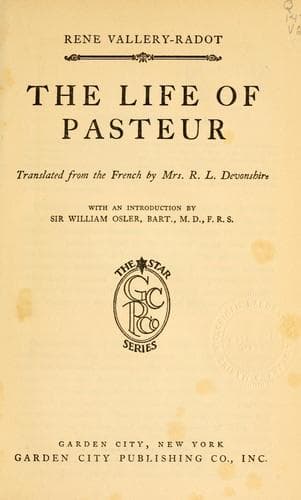
Pasteur, Louis, 1822-1895; Scientists -- France -- Biography
He carried his scruples so far as to give up his chemistry professorship
at the School of Fine Arts, where he had been lecturing since 1863. He
had endeavoured in his lessons to draw the attention of his artist
pupils, who came from so many distant places, to the actual principles
of Science. “Let us always make application our object,” he said, “but
resting on the stern and solid basis of scientific principles. Without
those principles, application is nothing more than a series of recipes
and constitutes what is called routine. Progress with routine is
possible, but desperately slow.”
Another reason prevented him from accepting the post offered him at the
Ecole Normale; this was that the tiny pavilion which he had made his
laboratory was much too small and too inconvenient to accommodate the
pupils he would have to teach. The only suitable laboratory at the Ecole
was that of his friend, Henri Sainte Claire Deville, and Pasteur was
reluctant to invade it. He had a great affection for his brilliant
colleague, who was indeed a particularly charming man, still youthful in
spite of his forty-nine summers, active, energetic, witty. “I have no
wit,” Pasteur would say quite simply. Deville was a great contrast to
his two great friends, Pasteur and Claude Bernard, with their grave
meditative manner. He enjoyed boarding at the Ecole and having his meals
at the students’ table, where his gaiety brightened and amused
everybody, effacing the distance between masters and pupils and yet
never losing by this familiar attitude a particle of the respect he
inspired.
Sometimes, however, when preoccupied with the heavy expenses of his
laboratory, he would invite himself to lunch with Duruy, from whom--as
from the Emperor or any one else--he usually succeeded in coaxing what
he wanted. The general state of things connected with higher education
was at that time most deplorable. The Sorbonne was as Richelieu had left
it--the Museum was sadly inadequate. At the Collège de France, it was
indeed impossible to call by the name of laboratory the narrow, damp and
unhealthy cellars, which Claude Bernard called “scientists’ graves,” and
where he had contracted the long illness from which he was only just
recovering.
Duruy understood and deplored this penury, but his voice was scarcely
heard in cabinet councils, the other Ministers being absorbed in
politics. Pasteur, whose self-effacing modesty disappeared when the
interests of science were in question, presented to Napoleon, through
the medium of his enlightened aide de camp, General Favé, the following
letter, a most interesting one, for, in it, possibilities of future
discoveries are hinted at, which later became accomplished facts.
Public-domain text, read in full here on John Shaqi.
Reviews
Reviews
No reviews yet
Be the first to share your thoughts on this work.
Elsewhere in the archive
Join the Discussion
Join the discussion
Sign in to leave a comment or review.
Sign InorCreate an account