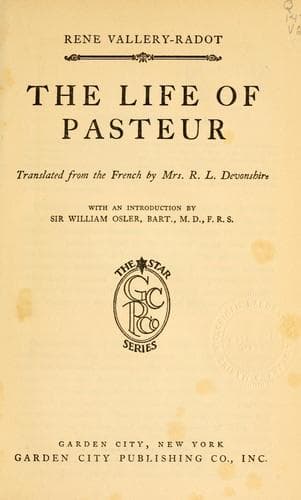
Pasteur, Louis, 1822-1895; Scientists -- France -- Biography
Duruy felt his combative instincts awakening. How many times, in spite
of his good humour and almost Roman intrepidity, he had asked himself
whether he would ever succeed in causing his ideas on higher education
to prevail with his colleagues, the other Ministers, who, carried away
by their daily discussions, hardly seemed to realize that the true
supremacy of a nation does not reside in speeches, but in the silent and
tenacious work of a few men of science and of letters. Pasteur’s article
entitled _Science’s Budget_ appeared first in the _Revue des cours
scientifiques_, then as a pamphlet. Pasteur, not content with this,
continued his campaign by impetuous speeches whenever the opportunity
offered. On March 10, he saw himself nearing his goal, and wrote to
Raulin: “There is now a marked movement in favour of Science; I think I
shall succeed.”
Six days later, on March 16, whilst the Court was celebrating the
birthday of the Prince Imperial, Napoleon III, who, on reading Pasteur’s
article, had expressed his intention of consulting not only Pasteur,
but also Milne-Edwards, Claude Bernard, and Henri Sainte Claire Deville,
asked the four scientists to his study to meet Rouher, Marshal Vaillant
and Duruy, perhaps the three men of the Empire who were best qualified
to hear them. The Emperor in his slow, detached manner, invited each of
his guests to express his opinion on the course to follow. All agreed in
regretting that pure science should be given up. When Rouher said that
it was not to be wondered at that the reign of applied science should
follow that of pure science, “But if the sources of applications are
dried up!” interposed the Emperor hastily. Pasteur, asked to express his
opinion (he had brought with him notes of what he wished to say),
recalled the fact that the Natural History Museum and the Ecole
Polytechnique, which had had so great a share in the scientific movement
of the early part of the century, were no longer in that heroic period.
For the last twenty years the industrial prosperity of France had
induced the cleverest Polytechnicians to desert higher studies and
theoretical science, though the source of all applications was to be
found in theory. The Ecole Polytechnique was obliged now to recruit its
teaching staff outside, chiefly among Normaliens. What was to be done to
train future scientists? This: to maintain in Paris, during two or three
years, five or six graduates chosen from the best students of the large
schools as curators or preparation masters, doing at the Ecole
Polytechnique and other establishments what was done at the Ecole
Normale. Thanks to that special institution, science and higher teaching
would have a reserve of men who would become an honour to their country.
Next, and this was the second point, no less important than the first,
scientists should be given resources better appropriated to the pursuit
of their work; as in Germany, for instance, where a scientist would
Public-domain text, read in full here on John Shaqi.
Reviews
Reviews
No reviews yet
Be the first to share your thoughts on this work.
Elsewhere in the archive
Join the Discussion
Join the discussion
Sign in to leave a comment or review.
Sign InorCreate an account