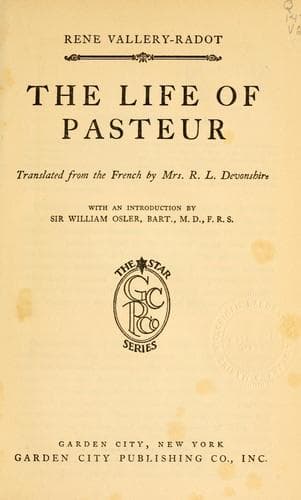
Pasteur, Louis, 1822-1895; Scientists -- France -- Biography
leave one university for another on the express condition that a
laboratory should be built for him, “a laboratory,” said Pasteur,
“usually magnificent, not in its architecture (though sometimes that is
the case, a proof of the national pride in scientific glory), but in the
number and perfection of its appliances. Besides,” he added, “foreign
scientists have their private homes adjoining their laboratories and
collections,” indeed a most pressing inducement to work.
Pasteur did not suggest that a scientist should give up teaching; he
recognized, on the contrary, that public teaching forces him to embrace
in succession every branch of the science he teaches. “But let him not
give too frequent or too varied lectures! they paralyze the faculties,”
he said, being well aware of the cost of preparing classes. He wished
that towns should be interested in the working and success of their
scientific establishments. The Universities of Paris, of Lyons, of
Strasburg, of Montpellier, of Lille, of Bordeaux, and of Toulouse,
forming as a whole the University of France, should be connected to the
neighbourhood which they honour in the same way that German universities
are connected with their surroundings.
Pasteur had the greatest admiration for the German system: popular
instruction liberally provided, and, above it, an intellectually
independent higher teaching. Therefore, when the University of Bonn
resolved in that year, 1868, to offer him as a great homage the degree
of M.D. on account of his works on micro-organisms, he was proud to see
his researches rated at their proper value by a neighbouring nation. He
did not then suspect the other side of German nature, the military side,
then very differently preoccupied. Those preoccupations were pointed out
to the French Government in a spirit of prophecy, and with some
patriotic anguish, by two French officers, General Ducrot, commanding
since 1865 the 6th Military Division, whose headquarters were at
Strasburg, and Colonel Baron Stoffel, military attaché in Prussia since
1866. Their warnings were so little heeded that some Court intrigues
were even then on foot to transfer General Ducrot from Strasburg to
Bourges, so that he might no longer worry people with his monomania of
Prussian ambition.
On March 10, the evening of the day when the Emperor decided upon making
improvements, and when Duruy felt assured, thanks to the promised
allowances, that he could soon offer to French professors “the necessary
appliances with which to compete with their rivals beyond the Rhine,”
Pasteur started for Alais, where his arrival was impatiently awaited,
both by partisans and adversaries of his experiments on silkworm
disease. He would much have liked to give the results of his work in his
inaugural lecture at the Sorbonne. “But,” he wrote to Duruy, “these are
but selfishly sentimental reasons, which must be outweighed by the
interest of my researches.”
Public-domain text, read in full here on John Shaqi.
Reviews
Reviews
No reviews yet
Be the first to share your thoughts on this work.
Elsewhere in the archive
Join the Discussion
Join the discussion
Sign in to leave a comment or review.
Sign InorCreate an account