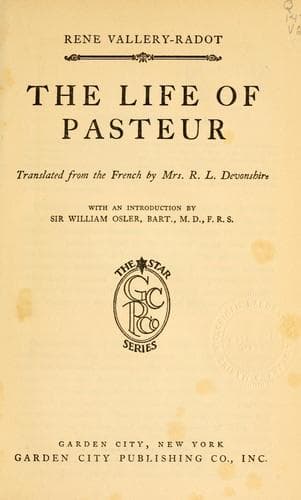
Pasteur, Louis, 1822-1895; Scientists -- France -- Biography
The building of the laboratory had been begun, and hoardings erected
around the site. Pasteur, from his bed, asked day by day, “How are they
getting on?” But his wife and daughter, going to the window of the
dining-room which overlooked the Ecole Normale garden, only brought him
back vague answers, for, as a matter of fact, the workmen had
disappeared from the very first day of Pasteur’s illness. All that could
be seen was a solitary labourer wheeling a barrow aimlessly about,
probably under the orders of some official who feared to alarm the
patient.
As Pasteur was not expected to recover, the trouble and expense were
deemed unnecessary. Pasteur soon became aware of this, and one day that
General Favé had come to see him he gave vent to some bitter feelings as
to this cautious interruption of the building works, saying that it
would have been simpler and more straightforward to state from the
beginning that the work was suspended in the expectation of a probable
demise.
Napoleon was informed of this excess of zeal, not only by General Favé,
but by Sainte Claire Deville, who was a guest at Compiègne at the
beginning of November, 1868. He wrote to the Minister of Public
Instruction--
“My dear M. Duruy,--I have heard that--unknown to you probably--the men
who were working at M. Pasteur’s laboratory were kept away from the very
day he became ill; he has been much affected by this circumstance,
which seemed to point to his non-recovery. I beg you will issue orders
that the work begun should be continued. Believe in my sincere
friendship.--Napoleon.”
Duruy immediately sent on this note to M. du Mesnil, whose somewhat long
title was that of “Chief of the Division of Academic Administration of
Scientific Establishments and of Higher Education.” M. du Mesnil
evidently repudiated the charge for himself or for his Minister, for he
wrote in a large hand, on the very margin of the Imperial autograph--
“M. Duruy gave no orders and had to give none. It is at his solicitation
that the works were undertaken, but it is the _Direction of Civic
Buildings_ alone which _can_ have interrupted them; the fact should be
verified.”
M. de Cardaillac, head of the Direction of Civic Buildings, made an
inquiry and the building was resumed.
It was only on November 30 that Pasteur left his bed for the first time
and spent an hour in his armchair. He clearly analyzed to himself his
melancholy condition, stricken down as he was by hemiplegia in his
forty-sixth year; but having noticed that his remarks saddened his wife
and daughter, he spoke no more about his illness, and only expressed his
anxiety not to be a trouble, a burden, he said, to his wife, his son and
daughter, and the devoted friends who helped to watch him at night.
Public-domain text, read in full here on John Shaqi.
Reviews
Reviews
No reviews yet
Be the first to share your thoughts on this work.
Elsewhere in the archive
Join the Discussion
Join the discussion
Sign in to leave a comment or review.
Sign InorCreate an account