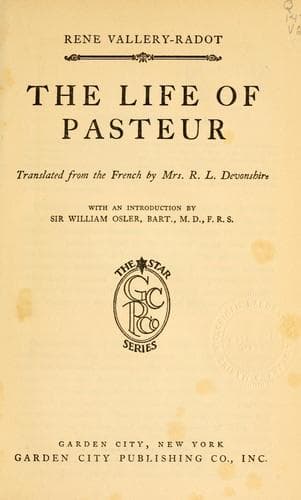
Pasteur, Louis, 1822-1895; Scientists -- France -- Biography
In the daytime each offered to read to him. General Favé, whose active
and inquiring mind was ever on the alert, brought him on one of his
almost daily visits an ideal sick man’s book, easy to read and offering
food for meditation. It was the translation of an English book called
_Self-Help_,[28] and it consisted in a series of biographies, histories
of lives illustrating the power of courage, devotion or intelligence.
The author, glad to expound a discovery, to describe a masterpiece, to
relate noble enterprises, to dwell upon the prodigies which energy can
achieve, had succeeded in making a homogeneous whole of these
unconnected narratives, a sort of homage to Willpower.
Pasteur agreed with the English writer in thinking that the supremacy of
a nation resides in “the sum total of private virtues, activities and
energy.” His thoughts rose higher still; men of science could wish for a
greater glory than that of contributing to the fame and fortune of
their country, they might aspire to originating vast benefits to the
whole of humanity.
It was indeed a sad and a sublime spectacle, that of the contrast
between that ardent, soaring soul and that patient helpless body. It was
probably when thinking of those biographies--some of them too succinct,
to his mind, Jenner’s for instance--that Pasteur wrote: “From the life
of men whose passage is marked by a trace of durable light, let us
piously gather up every word, every incident likely to make known the
incentives of their great soul, for the education of posterity.” He
looked upon the cult of great men as a great principle of national
education, and believed that children, as soon as they could read,
should be made acquainted with the heroic or benevolent souls of great
men. In his pious patriotism he saw a secret of strength and of hope for
a nation in its reverence for the memories of the great, a sacred and
intimate bond between the visible and the invisible worlds. His soul was
deeply religious. During his illness--a time when the things of this
world assume their real proportions--his mind rose far beyond this
earth. The Infinite appeared to him as it did to Pascal, and with the
same rapture; he was less attracted by Pascal, when, proud and
disdainful, he exposes man’s weakness for humiliation’s sake, than when
he declares that “Man is produced but for Infinity,” and “he finds
constant instruction in progress.” Pasteur believed in material progress
as well as in moral improvement; he invariably marked in the books he
was reading--Pascal, Nicole and others--those passages which were both
consoling and exalting.
Public-domain text, read in full here on John Shaqi.
Reviews
Reviews
No reviews yet
Be the first to share your thoughts on this work.
Elsewhere in the archive
Join the Discussion
Join the discussion
Sign in to leave a comment or review.
Sign InorCreate an account