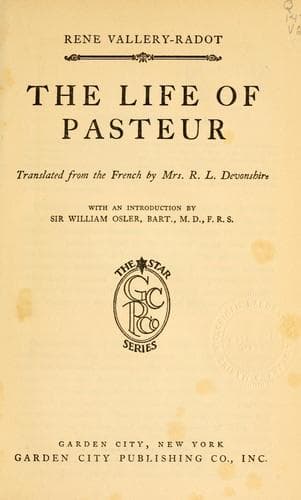
Pasteur, Louis, 1822-1895; Scientists -- France -- Biography
Before returning to France he went to Vienna and then to Munich: he
desired to talk with the German chemist, Liebig, the most determined of
his adversaries. He thought it impossible that Liebig’s ideas on
fermentation should not have been shaken and altered in the last
thirteen years. Liebig could not still be affirming that the presence of
decomposing animal or vegetable matter should be necessary to
fermentation! That theory had been destroyed by a simple and decisive
experiment of Pasteur’s: he had sown a trace of yeast in water
containing but sugar and mineral crystallized salts, and had seen this
yeast multiply itself and produce a regular alcoholic fermentation.
Since all nitrogenized organic matter (constituting the ferment,
according to Liebig) was absent, Pasteur considered that he thus proved
the life of the ferment and the absence of any action from albuminoid
matter in a stage of decomposition. The death phenomenon now appeared as
a life phenomenon. How could Liebig deny the independent existence of
ferments in their infinite littleness and their power of destroying and
transforming everything? What did he think of all these new ideas? would
he still write, as in 1845: “As to the opinion which explains
putrefaction of animal substances by the presence of microscopic
animalculæ, it may be compared to that of a child who would explain the
rapidity of the Rhine current by attributing it to the violent movement
of the numerous mill wheels of Mayence?”
Since that ingeniously fallacious paragraph, many results had come to
light. Perhaps Liebig, who in 1851 hailed J. B. Dumas as a master, had
now come to Dumas’ point of view respecting the fruitfulness of the
Pastorian theory. That theory was extended to diseases; the infinitely
small appeared as disorganizers of living tissues. The part played by
the corpuscles in the contagious and hereditary pébrine led to many
reflections on the contagious and hereditary element of human diseases.
Even the long-postponed transmission of certain diseases was becoming
clearer now that, within the vibrio of flachery, other corpuscles were
found, germs of the flachery disease, ready to break out from one year
to another.
To convince Liebig, to bring him to acknowledge the triumph of those
ideas with the pleasure of a true _savant_, such was Pasteur’s desire
when he entered Liebig’s laboratory. The tall old man, in a long frock
coat, received him with kindly courtesy; but when Pasteur, who was eager
to come to the object of his visit, tried to approach the delicate
subject, Liebig, without losing his amenity, refused all discussion,
alleging indisposition. Pasteur did not insist, but promised himself
that he would return to the charge.
CHAPTER VII
1870--1872
Public-domain text, read in full here on John Shaqi.
Reviews
Reviews
No reviews yet
Be the first to share your thoughts on this work.
Elsewhere in the archive
Join the Discussion
Join the discussion
Sign in to leave a comment or review.
Sign InorCreate an account