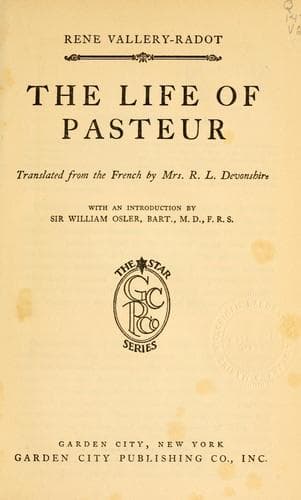
Pasteur, Louis, 1822-1895; Scientists -- France -- Biography
Pasteur, on his return, spent forty-eight hours in Strasburg, which was
for him full of memories of his laborious days at the Faculty of that
town, between 1848 and 1854, at a time when rivalry already existed
between France and Germany, a generous rivalry of moral and intellectual
effort. He then heard for the first time of the threatening war; all his
hopes of progress founded on peace, through scientific discoveries,
began to crumble away, and his disappointment was embittered by the
recollection of many illusions.
Never was more cruel rebuff given to the generous efforts of a policy of
sentiment: after having laid the foundation of the independence and
unity of Italy, France had sympathized with Germany’s desire for unity,
and few of the counsellors, or even the adversaries of the Empire, would
not have defended this idea, which was supposed to lead to civilization.
During that period of anxious waiting (beginning of July, 1870), when
the most alarming news was daily published in Strasburg, it did not
occur to any one to look back upon quotations from papers only a few
years old, though in that very town a pamphlet might have been found,
written by Edmond About in 1860, and containing the following words--
“Let Germany become united! France has no dearer or more ardent desire,
for she loves the German nation with a disinterested friendship. France
is not alarmed at seeing the formation of an Italian nation of
26,000,000 men in the South; she need not fear to see 32,000,000 Germans
found a great people on the Eastern frontier.”
Proud to be first to proclaim the rights of nations; influenced by
mingled feelings of kindliness, trustfulness, optimism and a certain
vanity of disinterestedness, France, who loves to be loved, imagined
that the world would be grateful for her international sociability, and
that her smiles were sufficient to maintain peace and joy in Europe.
Far from being alarmed by certain symptoms in her neighbours, she
voluntarily closed her eyes to the manœuvres of the Prussian troops, her
ears to the roar of the artillery practice constantly heard across her
eastern frontier; in 1863 patrols of German cavalry had come as far as
Wissemburg. But people thought that Germany was “playing soldiers.”
Duruy, who shared at that time the general delusion, wrote in some
traveller’s notes published in 1864: “We have had your German Rhine, and
though you have garnished it with bristling fortresses and cannon
turning France-wards, we do not wish to have it again, ... for the time
for conquests is past. Conquests shall only now be made with the free
consent of nations. Too much blood has been poured into the Rhine! What
an immense people would arise if they who were struck down by the sword
along its banks could be restored to life!”
Public-domain text, read in full here on John Shaqi.
Reviews
Reviews
No reviews yet
Be the first to share your thoughts on this work.
Elsewhere in the archive
Join the Discussion
Join the discussion
Sign in to leave a comment or review.
Sign InorCreate an account