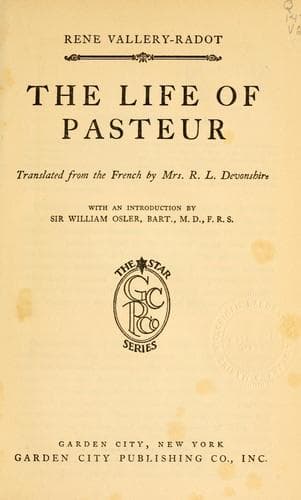
Pasteur, Louis, 1822-1895; Scientists -- France -- Biography
The capitulation of starving Paris and the proposed armistice are
historical events still present in the memory of men who were then
beginning to learn the meaning of defeat. The armistice, which Jules
Favre thought would be applied without restriction to all the army
corps, was interpreted by Bismarck in a peculiar way. He and Jules Favre
between them had drawn up a protocol in general terms; it had been
understood in those preliminary confabulations that, before drawing up
the limits of the neutral zone applicable to the Eastern Army Corps,
some missing information would be awaited, the respective positions of
the belligerents being unknown. The information did not come, and Jules
Favre in his imprudent trustfulness supposed that the delimitation
would be done on the spot by the officers in command. When he heard that
the Prussian troops were continuing their march eastwards, he complained
to Bismarck, who answered that “the incident cannot have compromised the
Eastern Army Corps, as it already was completely routed when the
armistice was signed.” This calculated reserve on Bismarck’s part was
eminently characteristic of his moral physiognomy, and this encounter
between the two Ministers proved once again the inferiority--when great
interests are at stake--of emotional men to hard-hearted business men;
however it must be acknowledged that Bismarck’s statement was founded on
fact. The Eastern Corps could have fought no more; its way was blocked.
Without food, without clothes, in many cases without arms, nothing
remained to the unfortunate soldiers but the refuge offered by
Switzerland.
Pasteur went to Geneva with his son, who, after recovering from the
illness caused by fatigue and privation, succeeded in getting back to
France to rejoin his regiment in the early days of February. Pasteur
then went on to Lyons and stayed there with his brother-in-law, M. Loir,
Dean of the Lyons Faculty of Science. He intended to go back to Paris,
but a letter from Bertin dated February 18 advised him to wait. “This is
the present state of the Ecole: south wing: pulled down; will be built
up again; workmen expected. Third year dormitory: ambulance occupied by
eight students. Science dormitory and drawing classroom: ambulance
again, forty patients. Ground floor classroom: 120 artillery-men.
Pasteur laboratory: 210 _gardes nationaux_, refugees from Issy. You had
better wait.” Bertin added, with his indomitable good humour, speaking
of the bombardment: “The first day I did not go out, but I took my
bearings and found the formula: in leaving the school, walk close along
the houses on my left; on coming back, keep close to them on my right;
with that I went out as usual. The population of Paris has shown
magnificent resignation and patience.... In order to have our revenge,
everything will have to be rebuilt from the top to the bottom, the top
especially.”
Public-domain text, read in full here on John Shaqi.
Reviews
Reviews
No reviews yet
Be the first to share your thoughts on this work.
Elsewhere in the archive
Join the Discussion
Join the discussion
Sign in to leave a comment or review.
Sign InorCreate an account