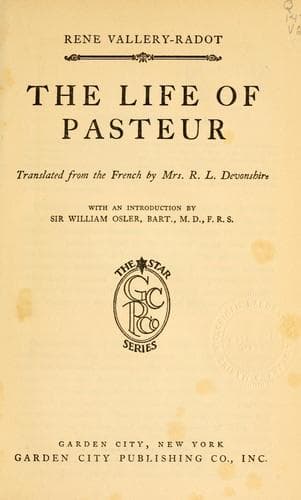
Pasteur, Louis, 1822-1895; Scientists -- France -- Biography
Pasteur also thought that reforms should begin from the top. He prepared
a paper dated from Lyons, and entitled “Why France found no superior men
in the hours of peril.” Amongst the mistakes committed, one in
particular had been before his mind for twenty years, ever since he left
the Ecole Normale: “The forgetfulness, disdain even, that France had
had for great intellectual men, especially in the realm of exact
science.” This seemed the more sad to him that things had been very
different at the end of the eighteenth century. Pasteur enumerated the
services rendered by science to his threatened country. If in 1792
France was able to face danger on all sides, it was because Lavoisier,
Fourcroy, Guyton de Morveau, Chaptal, Berthollet, etc., discovered new
means of extracting saltpetre and manufacturing gunpowder; because Monge
found a method of founding cannon with great rapidity; and because the
chemist Clouet invented a quick system of manufacturing steel. Science,
in the service of patriotism, made a victorious army of a perturbed
nation. If Marat, with his slanderous and injurious insinuations, had
not turned from their course the feelings of the mob, Lavoisier never
would have perished on the scaffold. The day after his execution,
Lagrange said: “One moment was enough for his head to fall, and 200
years may not suffice to produce such another.” Monge and Berthollet,
also denounced by Marat, nearly shared the same fate: “In a week’s time
we shall be arrested, tried, condemned and executed,” said Berthollet
placidly to Monge, who answered with equal composure, thinking only of
the country’s defence, “All I know is that my gun factories are working
admirably.”
Bonaparte, from the first, made of science what he would have made of
everything--a means of reigning. When he started for Egypt, he desired
to have with him a staff of scientists, and Monge and Berthollet
undertook to organize that distinguished company. Later, when Bonaparte
became Napoleon I, he showed, in the intervals between his wars, so much
respect for the place due to science as to proclaim the effacement of
national rivalry when scientific discoveries were in question. Pasteur,
when studying this side of the Imperial character, found in some pages
by Arago on Monge that, after Waterloo, Napoleon, in a conversation he
had with Monge at the Elysée, said, “Condemned now to command armies no
longer, I can see but Science with which to occupy my mind and my
soul....”
Public-domain text, read in full here on John Shaqi.
Reviews
Reviews
No reviews yet
Be the first to share your thoughts on this work.
Elsewhere in the archive
Join the Discussion
Join the discussion
Sign in to leave a comment or review.
Sign InorCreate an account