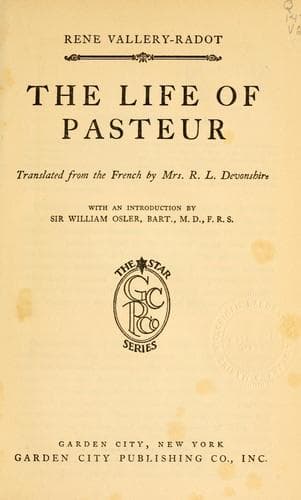
Pasteur, Louis, 1822-1895; Scientists -- France -- Biography
Pasteur, with the simplicity which contrasted with his extraordinary
powers, supposed that, if he were armed with diplomas, he would have
greater authority to direct Medicine towards the study of the conditions
of existence of phenomena, and--correlatively to the traditional method
of observation, which consists in knowing and describing exactly the
course of the disease--to inspire practitioners with the desire to
prevent and to determine its cause. An unexpected offer went some way
towards filling what he considered as a blank. At the beginning of the
year 1873, a place was vacant in the section of the Free Associates of
the Academy of Medicine. He was asked to stand for it, and hastened to
accept. He was elected with a majority of only one vote, though he had
been first on the section’s list. The other suffrages were divided
between Messrs. Le Roy de Méricourt, Brochin, Lhéritier, and Bertillon.
Pasteur, as soon as he was elected, promised himself that he would be a
most punctual academician. It was on a Tuesday in April that he attended
his first meeting. As he walked towards the desk allotted to him, his
paralyzed left leg dragging a little, no one among his colleagues
suspected that this quiet and unassuming new member would become the
greatest revolutionary ever known in Medicine.
One thing added to Pasteur’s pleasure in being elected--the fact that he
would join Claude Bernard. The latter had often felt somewhat forlorn in
that centre, where some hostility was so often to be seen towards all
that was outside the Clinic. This was the time when the “princes of
science,” or those who were considered as such, were all physicians.
Every great physician was conscious of being a ruling power. The almost
daily habit of advising and counselling was added to that idea of
haughty or benevolent superiority to the rest of the world; and,
accustomed to dictate his wishes, the physician frequently adopted an
authoritative tone and became a sort of personage. “Have you noticed,”
said Claude Bernard to Pasteur with a smile under which many feelings
were hidden, “that, when a doctor enters a room, he always looks as if
he was going to say, ‘I have just been saving a fellow-man’?”
Public-domain text, read in full here on John Shaqi.
Reviews
Reviews
No reviews yet
Be the first to share your thoughts on this work.
Elsewhere in the archive
Join the Discussion
Join the discussion
Sign in to leave a comment or review.
Sign InorCreate an account