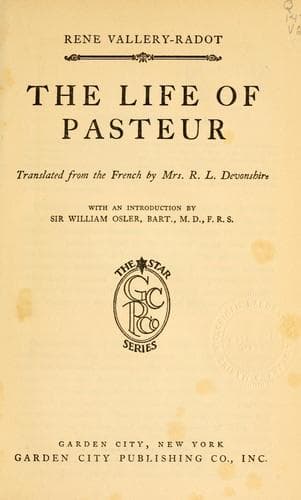
Pasteur, Louis, 1822-1895; Scientists -- France -- Biography
Pasteur knew not those harmless shafts which are a revenge for prolonged
pomposity. Why need Claude Bernard trouble to wonder what So-and-so
might think? He had the consciousness of the work accomplished and the
esteem and admiration of men whose suffrage more than satisfied him.
Whilst Pasteur was already desirous of spreading in the Académie
Médecine the faith which inspired him, Claude Bernard remembered the
refractory state of mind of those who, at the time of his first lectures
on experimental physiology applied to medicine, affirmed that
“physiology can be of no practical use in medicine; it is but a _science
de luxe_ which could well be dispensed with.” He energetically defended
this _science de luxe_ as the very science of life. In his opening
lecture at the Museum in 1870, he said that “descriptive anatomy is to
physiology as geography to history; and, as it is not sufficient to
understand the topography of a country to know its history, so is it not
enough to know the anatomy of an organ to understand its functions.”
Méry, an old surgeon, familiarly compared anatomists to those errand
boys in large towns, who know the names of the streets and the numbers
of the houses, but do not know what goes on inside. There are indeed in
tissues and organs physico-chemical phenomena for which anatomy cannot
account.
Claude Bernard was convinced that Medicine would gradually emerge from
quackery, and this by means of the experimental method, like all other
science. “No doubt,” he said, “we shall not live to see the blossoming
out of scientific medicine, but such is the fate of humanity; those that
sow on the field of science are not destined to reap the fruit of their
labours.” And so saying, Claude Bernard continued to sow.
It is true that here and there flashes of light had preceded Pasteur;
but, instead of being guided by them, most doctors continued to advance
majestically in the midst of darkness. Whenever murderous diseases,
scourges of humanity, were in question, long French or Latin words were
put forward, such as “Epidemic genius,” _fatum, quid ignotum quid
divinum_, etc. _Medical constitution_ was also a useful word, elastic
and applicable to anything.
When the Vale de Grâce physician, Villemin--a modest, gentle-voiced man,
who, under his quiet exterior, hid a veritable thirst for scientific
truth--after experimental researches carried on from 1865 to 1869,
brought the proof that tuberculosis is a disease which reproduces
itself, and cannot be reproduced but by itself; in a word, specific,
inoculable, and contagious, he was treated almost as a perturber of
medical order.
Public-domain text, read in full here on John Shaqi.
Reviews
Reviews
No reviews yet
Be the first to share your thoughts on this work.
Elsewhere in the archive
Join the Discussion
Join the discussion
Sign in to leave a comment or review.
Sign InorCreate an account