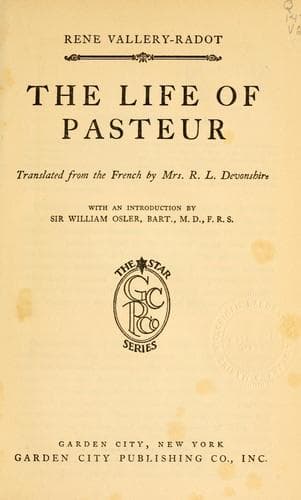
Pasteur, Louis, 1822-1895; Scientists -- France -- Biography
This was a mild way of putting it; M. Le Fort’s words were, “That
theory, in its applications to clinical surgery, is absolutely
inacceptable.” For him, the original purulent infection, though coming
from the wound, was born under the influence of general and local
phenomena _within_ the patient, and not _outside_ him. He believed that
the economy had the power, under various influences, to produce purulent
infection. A septic poison was created, born spontaneously, which was
afterwards carried to other patients by such medicines as the tools and
bandages and the hands of the surgeon. But, originally, before the
propagation of the contagium germ, a purulent infection was
spontaneously produced and developed. And, in order to put his teaching
into forcible words, M. Le Fort declared to the Académie de Médecine: “I
believe in the _interiority_ of the principle of purulent infection in
certain patients; that is why I oppose the extension to surgery of the
germ theory which proclaims the constant _exteriority_ of that
principle.”
Pasteur rose, and with his firm, powerful voice, exclaimed: “Before the
Academy accepts the conclusion of the paper we have just heard, before
the application of the germ theory to pathology is condemned, I beg that
I may be allowed to make a statement of the researches I am engaged in
with the collaboration of Messrs. Joubert and Chamberland.”
His impatience was so great that he formulated then and there some
headings for the lecture he was preparing, propositions on septicæmia or
putrid infection, on the septic vibrio itself, on the germs of that
vibrio carried by wind in the shape of dust, or suspended in water, on
the vitality of those germs, etc. He called attention to the mistakes
which might be made if, in that new acquaintance with microbes, their
morphologic aspect alone was taken account of. “The septic vibrio, for
instance, varies so much in its shape, length and thickness, according
to the media wherein it is cultivated, that one would think one was
dealing with beings specifically distinct from each other.”
It was on April 30, 1878, that Pasteur read that celebrated lecture on
the germ theory, in his own name and in that of Messrs. Joubert and
Chamberland. It began by a proud exordium: “All Sciences gain by mutual
support. When, subsequently to my early communications on fermentations,
in 1857--1858, it was admitted that ferments, properly so called, are
living beings; that germs of microscopical organisms abound on the
surface of all objects in the atmosphere and in water; that the
hypothesis of spontaneous generation is a chimera; that wines, beer,
vinegar, blood, urine and all the liquids of the economy are preserved
from their common changes when in contact with pure air--Medicine and
Surgery cast their eyes towards these new lights. A French physician, M.
Davaine, made a first successful application of those principles to
medicine in 1863.”
Public-domain text, read in full here on John Shaqi.
Reviews
Reviews
No reviews yet
Be the first to share your thoughts on this work.
Elsewhere in the archive
Join the Discussion
Join the discussion
Sign in to leave a comment or review.
Sign InorCreate an account