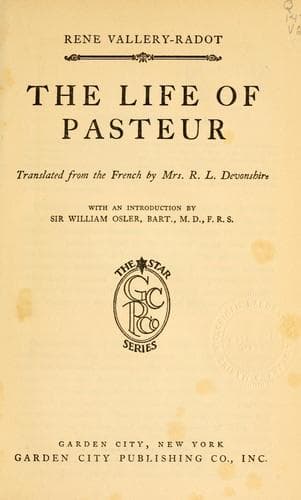
Pasteur, Louis, 1822-1895; Scientists -- France -- Biography
Pasteur himself, elected to the Académie des Sciences as a mineralogist,
proved by the concatenation of his studies within the last thirty years
that Science was indeed one and all embracing. Having thus called his
audience’s attention to the bonds which connect one scientific subject
with another, Pasteur proceeded to show the connection between his
yesterday’s researches on the etiology of Charbon to those he now
pursued on septicæmia. He hastily glanced back on his successful
cultures of the bacillus anthracis, and on the certain, indisputable
proof that the last culture acted equally with the first in producing
charbon within the body of animals. He then owned to the failure, at
first, of a similar method of cultivating the septic vibrio: “All our
first experiments failed in spite of the variety of culture media that
we used; beer-yeast water, meat broth, etc., etc....”
He then expounded, in the most masterly manner: (1) the idea which had
occurred to him that this vibrio might be an exclusively anaërobic
organism, and that the sterility of the liquids might proceed from the
fact that the vibrio was killed by the oxygen held in a state of
solution by those liquids; (2) the similarity offered by analogous facts
in connection with the vibrio of butyric fermentation, which not only
lives without air, but is killed by air; (3) the attempts made to
cultivate the septic vibrio in a vacuum or in the presence of carbonic
acid gas, and the success of both those attempts; and, finally, as the
result of the foregoing, the proof obtained that the action of the air
kills the septic vibriones, which are then seen to perish, under the
shape of moving threads, and ultimately to disappear, as if burnt away
by oxygen.
“If it is terrifying,” said Pasteur, “to think that life may be at the
mercy of the multiplication of those infinitesimally small creatures, it
is also consoling to hope that Science will not always remain powerless
before such enemies, since it is already now able to inform us that the
simple contact of air is sometimes sufficient to destroy them. But,” he
continued, meeting his hearers’ possible arguments, “if oxygen destroys
vibriones, how can septicæmia exist, as it does, in the constant
presence of atmospheric air? How can those facts be reconciled with the
germ theory? How can blood exposed to air become septic through the
dusts contained in air? All is dark, obscure and open to dispute when
the cause of the phenomena is not known; all is light when it is
grasped.”
Public-domain text, read in full here on John Shaqi.
Reviews
Reviews
No reviews yet
Be the first to share your thoughts on this work.
Elsewhere in the archive
Join the Discussion
Join the discussion
Sign in to leave a comment or review.
Sign InorCreate an account