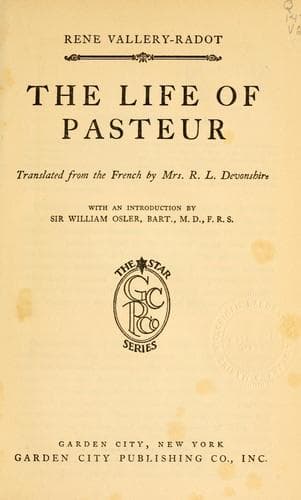
Pasteur, Louis, 1822-1895; Scientists -- France -- Biography
When Paul Bert, his favourite pupil, M. d’Arsonval, his curator, M.
Dastre, a former pupil, and M. Armand Moreau, his friend, came to see
him, he said to them in short, enigmatical sentences, with no comment or
experimental demonstration, that he had done some good work during the
vacation. “Pasteur will have to look out.... Pasteur has only seen one
side of the question.... I make alcohol without cells.... There is no
life without air....”
Bernard’s and Pasteur’s seats at the Academy of Sciences were next to
each other, and they usually enjoyed interchanging ideas. Claude Bernard
had come to the November and December sittings, but, with a reticence to
which he had not accustomed Pasteur, he had made no allusion to his
October experiments. In January, 1878, he became seriously ill; in his
conversations with M. d’Arsonval, who was affectionately nursing him,
Claude Bernard talked of his next lecture at the Museum, and said that
he would discuss his ideas with Pasteur before handling the subject of
fermentations. At the end of January M. d’Arsonval alluded to these
incomplete revelations. “It is all in my head,” said Claude Bernard,
“but I am too tired to explain it to you.” He made the same weary answer
two or three days before his death. When he succumbed, on February 10,
1878, Paul Bert, M. d’Arsonval and M. Dastre thought it their duty to
ascertain whether their master had left any notes relative to the work
which embodied his last thoughts. M. d’Arsonval, after a few days’
search, discovered some notes, carefully hidden in a cabinet in Claude
Bernard’s bedroom; they were all dated from the 1st to the 20th of
October, 1877; of November and December there was no record. Had he then
not continued his experiments during that period? Paul Bert thought that
these notes did not represent a work, not even a sketch, but a sort of
programme. “It was all condensed into a series of masterly conclusions,”
said Paul Bert, “which evidenced certitude, but there were no means of
discussing through which channel that certitude had come to his prudent
and powerful mind.” What should be done with those notes? Claude
Bernard’s three followers decided to publish them. “We must,” said Paul
Bert, “while telling the conditions under which the manuscript was
found, give it its character of incomplete notes, of confidences made to
itself by a great mind seeking its way, and marking its road
indiscriminately with facts and with hypotheses in order to arrive at
that feeling of certainty which, in the mind of a man of genius, often
precedes proof.” M. Berthelot, to whom the manuscript was brought,
presented these notes to the readers of the _Revue Scientifique_. He
pointed to their character, too abbreviated to conclude with a rigorous
demonstration, but he explained that several friends and pupils of
Claude Bernard had “thought that there would be some interest for
Science in preserving the trace of the last subjects of thought, however
Public-domain text, read in full here on John Shaqi.
Reviews
Reviews
No reviews yet
Be the first to share your thoughts on this work.
Elsewhere in the archive
Join the Discussion
Join the discussion
Sign in to leave a comment or review.
Sign InorCreate an account