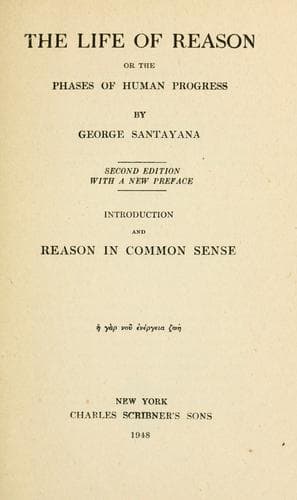
The Life of Reason: The Phases of Human ProgressSantayana, George
Philosophy
The Life of Reason: The Phases of Human Progress
Santayana, George
Philosophy
It is true that the theistic cosmology might hear a different
interpretation. If by deity we mean not man’s ideal—intellectual or
sensuous—but the total cosmic order, then the universal hierarchy may
be understood naturalistically so that each sphere gives scope for one
sort of good. God, or the highest being, would then be simply the life
of nature as a whole, if nature has a conscious life, or that of its
noblest portion. The supposed “metaphysical evil” involved in finitude
would then be no evil at all, but the condition of every good. In
realising his own will in his own way, each creature would be perfectly
happy, without yearning or pathetic regrets for other forms of being.
Such forms of being would all be unpalatable to him, even if
conventionally called higher, because their body was larger, and their
soul more complex. Nor would divine perfection itself be in any sense
perfection unless it gave expression to some definite nature, the
entelechy either of the celestial spheres, or of scientific thought, or
of some other actual existence. Under these circumstances, inhabitants
even of the lowest heaven would be unreservedly happy, as happy in their
way as those of the seventh heaven could be in theirs. No pathetic note
would any longer disquiet their finitude. They would not have to
renounce, in sad conformity to an alien will, what even for them would
have been a deeper joy. They would be asked to renounce nothing but
what, for them, would be an evil. The overruling providence would then
in truth be fatherly, by providing for each being that which it inwardly
craved. Persons of one rank would not be improved by passing into the
so-called higher sphere, any more than the ox would be improved by being
transformed into a lark, or a king into a poet.
Public-domain text, read in full here on John Shaqi.
Reviews
Reviews
No reviews yet
Be the first to share your thoughts on this work.
Elsewhere in the archive
Join the Discussion
Join the discussion
Sign in to leave a comment or review.
Sign InorCreate an account