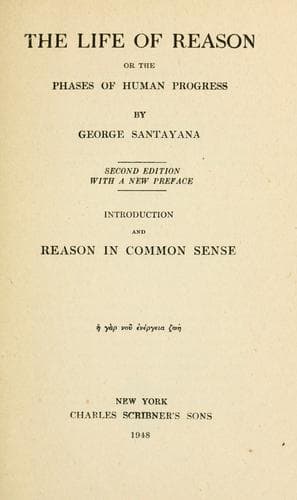
The Life of Reason: The Phases of Human ProgressSantayana, George
Philosophy
The Life of Reason: The Phases of Human Progress
Santayana, George
Philosophy
Man in such a system could no more pine to be God than he could pine to
be the law of gravity, or Spinoza’s substance, or Hegel’s dialectical
idea. Such naturalistic abstractions, while they perhaps express some
element of reality or its total form, are not objects corresponding to
man’s purposes and are morally inferior to his humanity. Every man’s
ideal lies within the potentialities of his nature, for only by
expressing his nature can ideals possess authority or attraction over
him. Heaven accordingly has really many mansions, each truly heavenly to
him who would inhabit it, and there is really no room for discord in
those rounds. One ideal can no more conflict with another than truth can
jostle truth; but men, or the disorganised functions within a given
individual, may be in physical conflict, as opinion may wrestle with
opinion in the world’s arena or in an ignorant brain. Among ideals
themselves infinite variety is consistent with perfect harmony, but
matter that has not yet developed or discovered its organic affinities
may well show groping and contradictory tendencies. When, however, these
embryonic disorders are once righted, each possible life knows its
natural paradise, and what some unintelligent outsider might say in
dispraise of that ideal will never wound or ruffle the self-justified
creature whose ideal it is, any more than a cat’s aversion to water will
disturb a fish’s plan of life.
[Sidenote: Theory that stations actually correspond to faculty.]
An aristocratic society might accordingly be a perfect heaven if the
variety and superposition of functions in it expressed a corresponding
diversity in its members’ faculties and ideals. And, indeed, what
aristocratic philosophers have always maintained is that men really
differ so much in capacity that one is happier for being a slave,
another for being a shopkeeper, and a third for being a king. All
professions, they say, even the lowest, are or may be vocations. Some
men, Aristotle tells us, are slaves by nature; only physical functions
are spontaneous in them. So long as they are humanely treated, it is,
we may infer, a benefit for them to be commanded; and the contribution
their labour makes toward rational life in their betters is the highest
dignity they can attain, and should be prized by them as a sufficient
privilege.
Public-domain text, read in full here on John Shaqi.
Reviews
Reviews
No reviews yet
Be the first to share your thoughts on this work.
Elsewhere in the archive
Join the Discussion
Join the discussion
Sign in to leave a comment or review.
Sign InorCreate an account