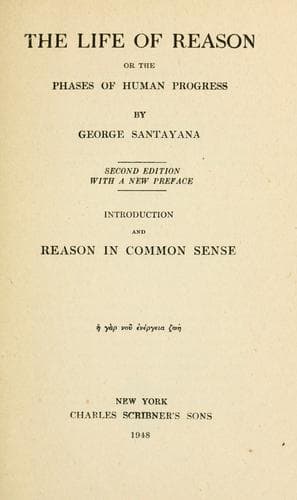
The Life of Reason: The Phases of Human ProgressSantayana, George
Philosophy
The Life of Reason: The Phases of Human Progress
Santayana, George
Philosophy
But so long as people remain on what such an invaluable optimist might
call the low level of sensuous thought, and so long as we imagine that
we exist and suffer, an aristocratic regimen can only be justified by
radiating benefit and by proving that were less given to those above
less would be attained by those beneath them. Such reversion of benefit
might take a material form, as when, by commercial guidance and military
protection, a greater net product is secured to labour, even after all
needful taxes have been levied upon it to support greatness. An
industrial and political oligarchy might defend itself on that ground.
Or the return might take the less positive form of opportunity, as it
does when an aristocratic society has a democratic government. Here the
people neither accept guidance nor require protection; but the existence
of a rich and irresponsible class offers them an ideal, such as it is,
in their ambitious struggles. For they too may grow rich, exercise
financial ascendancy, educate their sons like gentlemen, and launch
their daughters into fashionable society. Finally, if the only
aristocracy recognised were an aristocracy of achievement, and if public
rewards followed personal merit, the reversion to the people might take
the form of participation by them in the ideal interests of eminent men.
Holiness, genius, and knowledge can reverberate through all society. The
fruits of art and science are in themselves cheap and not to be
monopolised or consumed in enjoyment. On the contrary, their wider
diffusion stimulates their growth and makes their cultivation more
intense and successful. When an ideal interest is general the share
which falls to the private person is the more apt to be efficacious. The
saints have usually had companions, and artists and philosophers have
flourished in schools.
At the same time ideal goods cannot be assimilated without some training
and leisure. Like education and religion they are degraded by
popularity, and reduced from what the master intended to what the people
are able and willing to receive. So pleasing an idea, then, as this of
diffused ideal possessions has little application in a society
aristocratically framed; for the greater eminence the few attain the
less able are the many to follow them. Great thoughts require a great
mind and pure beauties a profound sensibility. To attempt to give such
things a wide currency is to be willing to denaturalise them in order to
boast that they have been propagated. Culture is on the horns of this
dilemma: if profound and noble it must remain rare, if common it must
become mean. These alternatives can never be eluded until some purified
and high-bred race succeeds the promiscuous bipeds that now blacken the
planet.
[Sidenote: Man adds wrong to nature’s injury.]
Public-domain text, read in full here on John Shaqi.
Reviews
Reviews
No reviews yet
Be the first to share your thoughts on this work.
Elsewhere in the archive
Join the Discussion
Join the discussion
Sign in to leave a comment or review.
Sign InorCreate an account