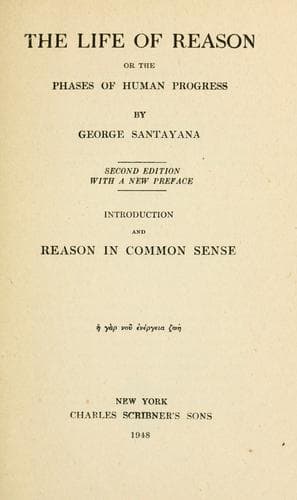
The Life of Reason: The Phases of Human ProgressSantayana, George
Philosophy
The Life of Reason: The Phases of Human Progress
Santayana, George
Philosophy
This oppression is the moral stain that attaches to aristocracy and
makes it truly unjust. Every privilege that imposes suffering involves a
wrong. Not only does aristocracy lay on the world a tax in labour and
privation that its own splendours, intellectual and worldly, may arise,
but by so doing it infects intelligence and grandeur with inhumanity and
renders corrupt and odious that pre-eminence which should have been
divine. The lower classes, in submitting to the hardship and meanness of
their lives—which, to be sure, might have been harder and meaner had no
aristocracy existed—must upbraid their fellow-men for profiting by
their ill fortune and therefore having an interest in perpetuating it.
Instead of the brutal but innocent injustice of nature, what they suffer
from is the sly injustice of men; and though the suffering be less—for
the worst of men is human—the injury is more sensible. The
inclemencies and dangers men must endure in a savage state, in scourging
them, would not have profited by that cruelty. But suffering has an
added sting when it enables others to be exempt from care and to live
like the gods in irresponsible ease; the inequality which would have
been innocent and even beautiful in a happy world becomes, in a painful
world, a bitter wrong, or at best a criminal beauty.
[Sidenote: A hint to optimists.]
It would be a happy relief to the aristocrat’s conscience, when he
possesses one, could he learn from some yet bolder Descartes that common
people were nothing but _bêtes-machines_, and that only a groundless
prejudice had hitherto led us to suppose that life could exist where
evidently nothing good could be attained by living. If all unfortunate
people could be proved to be unconscious automata, what a brilliant
justification that would be for the ways of both God and man! Philosophy
would not lack arguments to support such an agreeable conclusion.
Beginning with the axiom that whatever is is right, a metaphysician
might adduce the truth that consciousness is something self-existent and
indubitably real; therefore, he would contend, it must be
self-justifying and indubitably good. And he might continue by saying
that a slave’s life was not its own excuse for being, nor were the
labours of a million drudges otherwise justified than by the
conveniences which they supplied their masters with. _Ergo_, those
servile operations could come to consciousness only where they attained
their end, and the world could contain nothing but perfect and universal
happiness. A divine omniscience and joy, shared by finite minds in so
far as they might attain perfection, would be the only life in
existence, and the notion that such a thing as pain, sorrow, or hatred
could exist at all would forthwith vanish like the hideous and
ridiculous illusion that it was. This argument may be recommended to
apologetic writers as no weaker than those they commonly rely on, and
infinitely more consoling.
[Sidenote: How aristocracies might do good.]
Public-domain text, read in full here on John Shaqi.
Reviews
Reviews
No reviews yet
Be the first to share your thoughts on this work.
Elsewhere in the archive
Join the Discussion
Join the discussion
Sign in to leave a comment or review.
Sign InorCreate an account