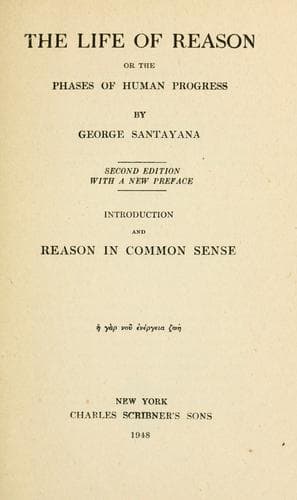
The Life of Reason: The Phases of Human ProgressSantayana, George
Philosophy
The Life of Reason: The Phases of Human Progress
Santayana, George
Philosophy
Ideal society is a drama enacted exclusively in the imagination. Its
personages are all mythical, beginning with that brave protagonist who
calls himself I and speaks all the soliloquies. When most nearly
material these personages are human souls—the ideal life of particular
bodies—or floating mortal reputations—echoes of those ideal lives in
one another. From this relative substantiality they fade into notions of
country, posterity, humanity, and the gods. These figures all represent
some circle of events or forces in the real world; but such
representation, besides being mythical, is usually most inadequate. The
boundaries of that province which each spirit presides over are vaguely
drawn, the spirit itself being correspondingly indefinite. This
ambiguity is most conspicuous, perhaps, in the most absorbing of the
personages which a man constructs in this imaginative fashion—his idea
of himself. “There is society where none intrudes;” and for most men
sympathy with their imaginary selves is a powerful and dominant emotion.
True memory offers but a meagre and interrupted vista of past
experience, yet even that picture is far too rich a term for mental
discourse to bandy about; a name with a few physical and social
connotations is what must represent the man to his own thinkings. Or
rather it is no memory, however eviscerated, that fulfils that office. A
man’s notion of himself is a concretion in discourse for which his more
constant somatic feelings, his ruling interests, and his social
relations furnish most of the substance.
[Sidenote: Romantic egotism.]
The more reflective and self-conscious a man is the more completely will
his experience be subsumed and absorbed in his perennial “I.” If
philosophy has come to reinforce this reflective egotism, he may even
regard all nature as nothing but his half-voluntary dream and encourage
himself thereby to give even to the physical world a dramatic and
sentimental colour. But the more successful he is in stuffing everything
into his self-consciousness, the more desolate will the void become
which surrounds him. For self is, after all, but one term in a primitive
dichotomy and would lose its specific and intimate character were it no
longer contrasted with anything else. The egotist must therefore people
the desert he has spread about him, and he naturally peoples it with
mythical counterparts of himself. Sometimes, if his imagination is
sensuous, his alter-egos are incarnate in the landscape, and he creates
a poetic mythology; sometimes, when the inner life predominates, they
are projected into his own forgotten past or infinite future. He will
then say that all experience is really his own and that some
inexplicable illusion has momentarily raised opaque partitions in his
omniscient mind.
[Sidenote: Vanity.]
Public-domain text, read in full here on John Shaqi.
Reviews
Reviews
No reviews yet
Be the first to share your thoughts on this work.
Elsewhere in the archive
Join the Discussion
Join the discussion
Sign in to leave a comment or review.
Sign InorCreate an account