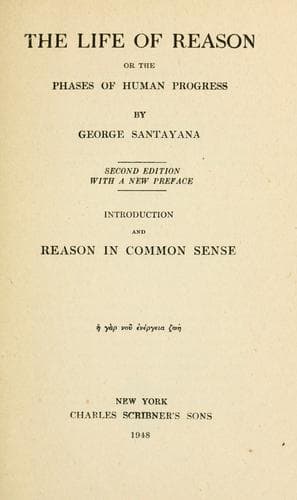
The Life of Reason: The Phases of Human ProgressSantayana, George
Philosophy
The Life of Reason: The Phases of Human Progress
Santayana, George
Philosophy
Philosophers less pretentious and more worldly than these have sometimes
felt, in their way, the absorbing force of self-consciousness. La
Rochefoucauld could describe _amour propre_ as the spring of all human
sentiments. _Amour propre_ involves preoccupation not merely with the
idea of self, but with that idea reproduced in other men’s minds; the
soliloquy has become a dialogue, or rather a solo with an echoing
chorus. Interest in one’s own social figure is to some extent a material
interest, for other men’s love or aversion is a principle read into
their acts; and a social animal like man is dependent on other men’s
acts for his happiness. An individual’s concern for the attitude society
takes toward him is therefore in the first instance concern for his own
practical welfare. But imagination here refines upon worldly interest.
What others think of us would be of little moment did it not, when
known, so deeply tinge what we think of ourselves. Nothing could better
prove the mythical character of self-consciousness than this extreme
sensitiveness to alien opinions; for if a man really knew himself he
would utterly despise the ignorant notions others might form on a
subject in which he had such matchless opportunities for observation.
Indeed, those opinions would hardly seem to him directed upon the
reality at all, and he would laugh at them as he might at the stock
fortune-telling of some itinerant gypsy.
As it is, however, the least breath of irresponsible and anonymous
censure lashes our self-esteem and sometimes quite transforms our plans
and affections. The passions grafted on wounded pride are the most
inveterate; they are green and vigorous in old age. We crave support in
vanity, as we do in religion, and never forgive contradictions in that
sphere; for however persistent and passionate such prejudices may be, we
know too well that they are woven of thin air. A hostile word, by
starting a contrary imaginative current, buffets them rudely and
threatens to dissolve their being.
[Sidenote: Ambiguities of fame.]
Public-domain text, read in full here on John Shaqi.
Reviews
Reviews
No reviews yet
Be the first to share your thoughts on this work.
Elsewhere in the archive
Join the Discussion
Join the discussion
Sign in to leave a comment or review.
Sign InorCreate an account