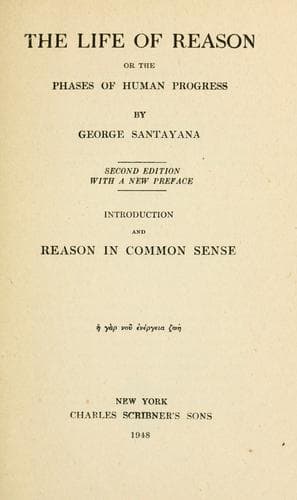
The Life of Reason: The Phases of Human ProgressSantayana, George
Philosophy
The Life of Reason: The Phases of Human Progress
Santayana, George
Philosophy
Comradeship is a form of friendship still akin to general sociability
and gregariousness. When men are “in the same boat together,” when a
common anxiety, occupation, or sport unites them, they feel their human
kinship in an intensified form without any greater personal affinity
subsisting between them. The same effect is produced by a common
estrangement from the rest of society. For this reason comradeship lasts
no longer than the circumstances that bring it about. Its constancy is
proportionate to the monotony of people’s lives and minds. There is a
lasting bond among schoolfellows because no one can become a boy again
and have a new set of playmates. There is a persistent comradeship with
one’s countrymen, especially abroad, because seldom is a man pliable and
polyglot enough to be at home among foreigners, or really to understand
them. There is an inevitable comradeship with men of the same breeding
or profession, however bad these may be, because habits soon monopolise
the man. Nevertheless a greater buoyancy, a longer youth, a richer
experience, would break down all these limits of fellowship. Such
clingings to the familiar are three parts dread of the unfamiliar and
want of resource in its presence, for one part in them of genuine
loyalty. Plasticity loves new moulds because it can fill them, but for a
man of sluggish mind and bad manners there is decidedly no place like
home.
[Sidenote: External conditions of friendship.]
Though comradeship is an accidental bond, it is the condition of ideal
friendship, for the ideal, in all spheres, is nothing but the accidental
confirming itself and generating its own standard. Men must meet to
love, and many other accidents besides conjunction must conspire to make
a true friendship possible. In order that friendship may fulfil the
conditions even of comradeship, it is requisite that the friends have
the same social status, so that they may live at ease together and have
congenial tastes. They must further have enough community of occupation
and gifts to give each an appreciation of the other’s faculty; for
qualities are not complementary unless they are qualities of the same
substance. Nothing must be actual in either friend that is not potential
in the other.
[Sidenote: Identity in sex required.]
Public-domain text, read in full here on John Shaqi.
Reviews
Reviews
No reviews yet
Be the first to share your thoughts on this work.
Elsewhere in the archive
Join the Discussion
Join the discussion
Sign in to leave a comment or review.
Sign InorCreate an account