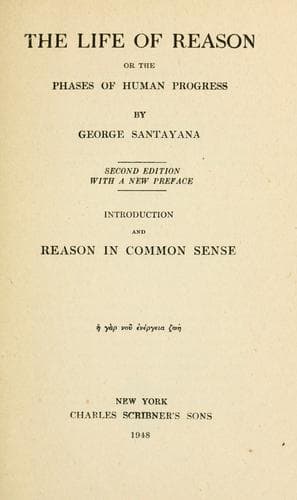
The Life of Reason: The Phases of Human ProgressSantayana, George
Philosophy
The Life of Reason: The Phases of Human Progress
Santayana, George
Philosophy
What we may conceive to have come in this way even within a Horace’s
apprehension is undoubtedly what has attached many nobler souls to fame.
With an inversion of moral derivations which all mythical expression
involves we speak of fame as the reward of genius, whereas in truth
genius, the imaginative dominion of experience, is its own reward and
fame is but a foolish image by which its worth is symbolised. When the
Virgin in the Magnificat says, “Behold, from henceforth all generations
shall call me blessed,” the psalmist surely means to express a
spiritual exaltation exempt from vanity; he merely translates into a
rhetorical figure the fact that what had been first revealed to Mary
would also bless all generations. That the Church should in consequence
deem and pronounce her blessed is an incident describing, but not
creating, the unanimity in their religious joys. Fame is thus the
outward sign or recognition of an inward representative authority
residing in genius or good fortune, an authority in which lies the whole
worth of fame. Those will substantially remember and honour us who keep
our ideals, and we shall live on in those ages whose experience we have
anticipated.
Free society differs from that which is natural and legal precisely in
this, that it does not cultivate relations which in the last analysis
are experienced and material, but turns exclusively to unanimities in
meanings, to collaborations in an ideal world. The basis of free society
is of course natural, as we said, but free society has ideal goals.
Spirits cannot touch save by becoming unanimous. At the same time public
opinion, reputation, and impersonal sympathy reinforce only very general
feelings, and reinforce them vaguely; and as the inner play of sentiment
becomes precise, it craves more specific points of support or
comparison. It is in creatures of our own species that we chiefly scent
the aroma of inward sympathy, because it is they that are visibly moved
on the same occasions as ourselves; and it is to those among our
fellow-men who share our special haunts and habits that we feel more
precise affinities. Though the ground for such feeling is animal contact
and contagion, its deliverance does not revert to those natural
accidents, but concerns a represented sympathy in represented souls.
Friendship, springing from accidental association, terminates in a
consciousness of ideal and essential agreement.
[Sidenote: Comradeship.]
Public-domain text, read in full here on John Shaqi.
Reviews
Reviews
No reviews yet
Be the first to share your thoughts on this work.
Elsewhere in the archive
Join the Discussion
Join the discussion
Sign in to leave a comment or review.
Sign InorCreate an account