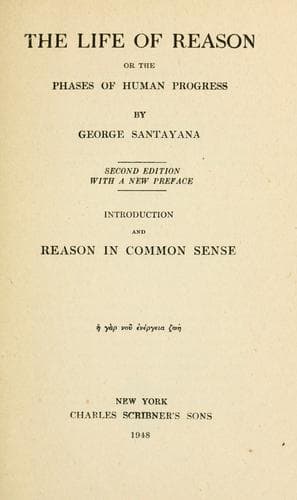
The Life of Reason: The Phases of Human ProgressSantayana, George
Philosophy
The Life of Reason: The Phases of Human Progress
Santayana, George
Philosophy
All these are merely permissive conditions for friendship; its positive
essence is yet to find. How, we may ask, does the vision of the general
_socius_, humanity, become specific in the vision of a particular friend
without losing its ideality or reverting to practical values? Of course,
individuals might be singled out for the special benefits they may have
conferred; but a friend’s only gift is himself, and friendship is not
friendship, it is not a form of free or liberal society, if it does not
terminate in an ideal possession, in an object loved for its own sake.
Such objects can be ideas only, not forces, for forces are subterranean
and instrumental things, having only such value as they borrow from
their ulterior effects and manifestations. To praise the utility of
friendship, as the ancients so often did, and to regard it as a
political institution justified, like victory or government, by its
material results, is to lose one’s moral bearings. The value of victory
or good government is rather to be found in the fact that, among other
things, it might render friendship possible. We are not to look now for
what makes friendship useful, but for whatever may be found in
friendship that may lend utility to life.
[Sidenote: Personal liking.]
The first note that gives sociability a personal quality and raises the
comrade into an incipient friend is doubtless sensuous affinity.
Whatever reaction we may eventually make on an impression, after it has
had time to soak in and to merge in some practical or intellectual
habit, its first assault is always on the senses, and no sense is an
indifferent organ. Each has, so to speak, its congenial rate of
vibration and gives its stimuli a varying welcome. Little as we may
attend to these instinctive hospitalities of sense, they betray
themselves in unjustified likes and dislikes felt for casual persons and
things, in the _je ne sais quoi_ that makes instinctive sympathy. Voice,
manner, aspect, hints of congenial tastes and judgments, a jest in the
right key, a gesture marking the right aversions, all these trifles
leave behind a pervasive impression. We reject a vision we find
indigestible and without congruity to our inner dream; we accept and
incorporate another into our private pantheon, where it becomes a
legitimate figure, however dumb and subsidiary it may remain.
Public-domain text, read in full here on John Shaqi.
Reviews
Reviews
No reviews yet
Be the first to share your thoughts on this work.
Elsewhere in the archive
Join the Discussion
Join the discussion
Sign in to leave a comment or review.
Sign InorCreate an account