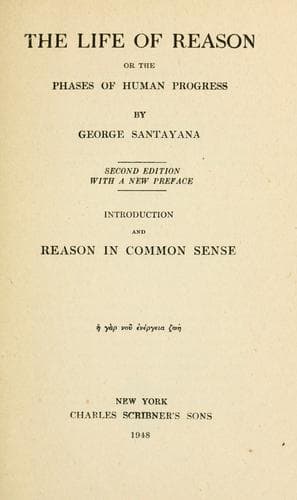
The Life of Reason: The Phases of Human ProgressSantayana, George
Philosophy
The Life of Reason: The Phases of Human Progress
Santayana, George
Philosophy
In a refined nature these sensuous premonitions of sympathy are seldom
misleading. Liking cannot, of course, grow into friendship over night as
it might into love; the pleasing impression, even if retained, will lie
perfectly passive and harmless in the mind, until new and different
impressions follow to deepen the interest at first evoked and to remove
its centre of gravity altogether from the senses. In love, if the field
is clear, a single glimpse may, like Tristan’s potion, produce a violent
and irresistible passion; but in friendship the result remains more
proportionate to the incidental causes, discrimination is preserved,
jealousy and exclusiveness are avoided. That vigilant, besetting,
insatiable affection, so full of doubts and torments, with which the
lover follows his object, is out of place here; for the friend has no
property in his friend’s body or leisure or residual ties; he accepts
what is offered and what is acceptable, and the rest he leaves in peace.
He is distinctly not his brother’s keeper, for the society of friends is
free.
[Sidenote: The refracting human medium for ideas.]
Friendship may indeed come to exist without sensuous liking or
comradeship to pave the way; but unless intellectual sympathy and moral
appreciation are powerful enough to react on natural instinct and to
produce in the end the personal affection which at first was wanting,
friendship does not arise. Recognition given to a man’s talent or virtue
is not properly friendship. Friends must desire to live as much as
possible together and to share their work, thoughts, and pleasures.
Good-fellowship and sensuous affinity are indispensable to give
spiritual communion a personal accent; otherwise men would be
indifferent vehicles for such thoughts and powers as emanated from them,
and attention would not be in any way arrested or refracted by the human
medium through which it beheld the good.
[Sidenote: Affection based on the refraction.]
No natural vehicle, however, is indifferent; no natural organ is or
should be transparent. Transparency is a virtue only in artificial
instruments, organs in which no blood flows and whose intrinsic
operation is not itself a portion of human life. In looking through a
field-glass I do not wish to perceive the lenses nor to see rainbows
about their rim; yet I should not wish the eye itself to lose its
pigments and add no dyes to the bulks it discerns. The sense for colour
is a vital endowment and an ingredient in human happiness; but no
vitality is added by the intervention of further media which are not
themselves living organs.
Public-domain text, read in full here on John Shaqi.
Reviews
Reviews
No reviews yet
Be the first to share your thoughts on this work.
Elsewhere in the archive
Join the Discussion
Join the discussion
Sign in to leave a comment or review.
Sign InorCreate an account