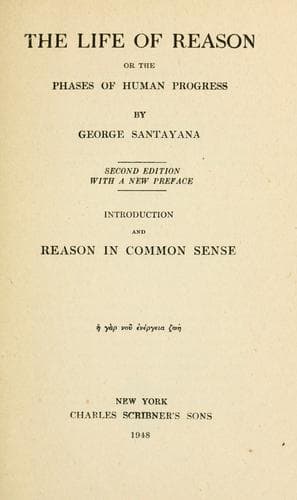
The Life of Reason: The Phases of Human ProgressSantayana, George
Philosophy
The Life of Reason: The Phases of Human Progress
Santayana, George
Philosophy
When intelligence is not keen this idea may remain sensuous. The
visible instruments of social life—chieftains, armies, monuments, the
dialect and dress of the district, with all customs and pleasures
traditional there—these are what a sensuous man may understand by his
country. Bereft of these sensations he would feel lost and incapable;
the habits formed in that environment would be galled by any other. This
fondness for home, this dread of change and exile, is all the love of
country he knows. If by chance, without too much added thought, he could
rise to a certain poetic sentiment, he might feel attachment also to the
landscape, to the memorable spots and aspects of his native land. These
objects, which rhetoric calls sacred, might really have a certain
sanctity for him; a wave of pious emotion might run over him at the
sight of them, a pang when in absence they were recalled. These very
things, however, like the man who prizes them, are dependent on a much
larger system; and if patriotism is to embrace ideally what really
produces human well-being it should extend over a wider field and to
less picturable objects.
[Sidenote: Ambiguous limits of a native country, geographical and
moral.]
To define one’s country is not so simple a matter as it may seem. The
habitat of a man’s youth, to which actual associations may bind him, is
hardly his country until he has conceived the political and historical
forces that include that habitat in their sphere of influence and have
determined its familiar institutions. Such forces are numerous and
their spheres include one another like concentric rings. France, for
instance, is an uncommonly distinct and self-conscious nation, with a
long historic identity and a compact territory. Yet what is the France a
Frenchman is to think of and love? Paris itself has various quarters and
moral climates, one of which may well be loved while another is
detested. The provinces have customs, temperaments, political ideals,
and even languages of their own. Is Alsace-Lorraine beyond the pale of
French patriotism? And if not, why utterly exclude French-speaking
Switzerland, the Channel Islands, Belgium, or Quebec? Or is a Frenchman
rather to love the colonies by way of compensation? Is an Algerian Moor
or a native of Tonquin his true fellow-citizen? Is Tahiti a part of his
“country”? The truth is, if we look at the heart of the matter, a
Protestant born in Paris is less a Frenchman than is a Catholic born in
Geneva.
Public-domain text, read in full here on John Shaqi.
Reviews
Reviews
No reviews yet
Be the first to share your thoughts on this work.
Elsewhere in the archive
Join the Discussion
Join the discussion
Sign in to leave a comment or review.
Sign InorCreate an account