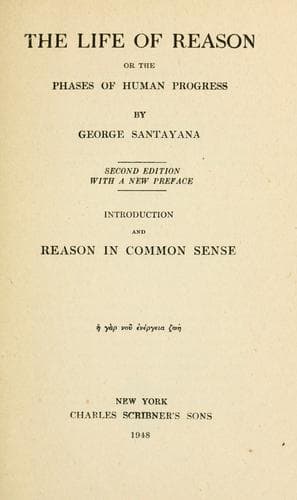
The Life of Reason: The Phases of Human ProgressSantayana, George
Philosophy
The Life of Reason: The Phases of Human Progress
Santayana, George
Philosophy
A disembodied ideal, however, is unmanageable and vague; it cannot
exercise the natural and material suasion proper to a model we are
expected to imitate. The more fruitful procedure is accordingly to
idealise some historical figure or natural force, to ignore or minimise
in it what does not seem acceptable, and to retain at the same time all
the unobjectionable personal colour and all the graphic traits that can
help to give that model a persuasive vitality. This poetic process is
all the more successful for being automatic. It is in this way that
heroes and gods have been created. A legend or fable lying in the mind
and continually repeated gained insensibly at each recurrence some new
eloquence, some fresh congruity with the emotion it had already
awakened, and was destined to awake again. To measure the importance of
this truth the reader need only conceive the distance traversed from the
Achilles that may have existed to the hero in Homer, or from Jesus as he
might have been in real life, or even as he is in the gospels, to Christ
in the Church.
CHAPTER VII
PATRIOTISM
[Sidenote: The creative social environment, since it eludes sense, must
be represented symbolically.]
The mythical social idea most potent over practical minds is perhaps the
idea of country. When a tribe, enlarged and domiciled, has become a
state, much social feeling that was before evoked by things visible
loses its sensuous object. Yet each man remains no less dependent than
formerly on his nation, although less swayed by its visible presence and
example; he is no less concerned, materially and ideally, in the
fortunes of the community. If a sense for social relations is to endure,
some symbol must take the place of the moving crowd, the visible
stronghold, and the outspread fields and orchards that once made up his
country; some intellectual figment must arise to focus political
interests, no longer confined to the crops and the priest’s medicinal
auguries. It is altogether impossible that the individual should have a
discursive and adequate knowledge of statecraft and economy. Whatever
idea, then, he frames to represent his undistinguished political
relations becomes the centre of his patriotism.
Public-domain text, read in full here on John Shaqi.
Reviews
Reviews
No reviews yet
Be the first to share your thoughts on this work.
Elsewhere in the archive
Join the Discussion
Join the discussion
Sign in to leave a comment or review.
Sign InorCreate an account