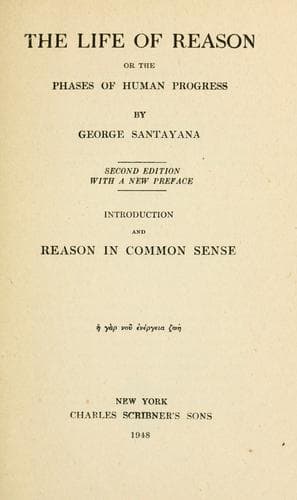
The Life of Reason: The Phases of Human ProgressSantayana, George
Philosophy
The Life of Reason: The Phases of Human Progress
Santayana, George
Philosophy
The springs of culture, which retrospective patriotism regards, go back
in the last instance to cosmic forces. The necessity that marshals the
stars makes possible the world men live in, and is the first general and
law-giver to every nation. The earth’s geography, its inexorable
climates with their flora and fauna, make a play-ground for the human
will which should be well surveyed by any statesman who wishes to judge
and act, not fantastically, but with reference to the real situation.
Geography is a most enlightening science. In describing the habitat of
man it largely explains his history. Animal battles give the right and
only key to human conflicts, for the superadded rational element in man
is not partisan, but on the contrary insinuates into his economy the
novel principle of justice and peace. As this leaven, however, can
mingle only with elements predisposed to receive it, the basis of reason
itself, in so far as it attains expression, must be sought in the
natural world. The fortunes of the human family among the animals thus
come to concern reason and to be the background of progress.
Within humanity the next sphere of interest for a patriot is the race
from which he is descended, with its traditional languages and
religions. Blood is the ground of character and intelligence. The fruits
of civilisation may, indeed, be transmitted from one race to another and
consequently a certain artificial homogeneity may be secured amongst
different nations; yet unless continual intermarriage takes place each
race will soon recast and vitiate the common inheritance. The fall of
the Roman Empire offered such a spectacle, when various types of
barbarism, with a more or less classic veneer, re-established themselves
everywhere. Perhaps modern cosmopolitanism, if not maintained by
commerce or by permanent conquest, may break apart in the same way and
yield to local civilisations no less diverse than Christendom and Islam.
[Sidenote: Race, when distinct, the greatest of distinctions.]
Public-domain text, read in full here on John Shaqi.
Reviews
Reviews
No reviews yet
Be the first to share your thoughts on this work.
Elsewhere in the archive
Join the Discussion
Join the discussion
Sign in to leave a comment or review.
Sign InorCreate an account