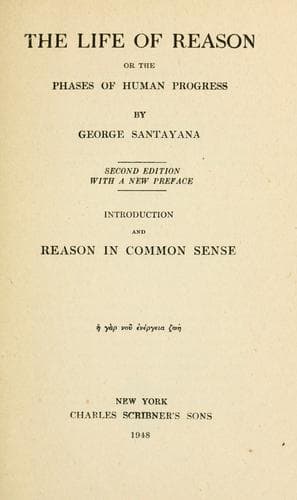
The Life of Reason: The Phases of Human ProgressSantayana, George
Philosophy
The Life of Reason: The Phases of Human Progress
Santayana, George
Philosophy
Community of race is a far deeper bond than community of language,
education, or government. Where one political system dominates various
races it forces their common culture to be external merely. This is
perhaps the secret of that strange recrudescence of national feeling,
apart often from political divisions, which has closely followed the
French Revolution and the industrial era. The more two different peoples
grow alike in externals the more conscious and jealous they become of
diversity in their souls; and where individuals are too insignificant to
preserve any personality or distinction of their own, they flock
together into little intentional societies and factious groups, in the
hope of giving their imagination, in its extremity, some little food and
comfort. Private nationalities and private religions are luxuries at
such a time in considerable demand. The future may possibly see in the
Occident that divorce between administrative and ideal groups which is
familiar in the Orient; so that under no matter what government and with
utter cosmopolitanism in industry and science, each race may guard its
own poetry, religion, and manners. Such traditions, however, would
always be survivals or revivals rather than genuine expressions of life,
because mind must either represent nature and the conditions of action
or else be content to persist precariously and without a function, like
a sort of ghost.
[Sidenote: “Pure” races may be morally sterile.]
Some races are obviously superior to others. A more thorough adjustment
to the conditions of existence has given their spirit victory, scope,
and a relative stability. It is therefore of the greatest importance not
to obscure this superiority by intermarriage with inferior stock, and
thus nullify the progress made by a painful evolution and a prolonged
sifting of souls. Reason protests as much as instinct against any
fusion, for instance, of white and black peoples. Mixture is in itself
no evil if the two nations, being approximately equal, but having
complementary gifts, can modify them without ultimate loss, and possibly
to advantage. Indeed the so-called pure races, since their purity has
gone with isolation and inexperience, have borne comparatively little
spiritual fruit. Large contact and concentrated living bring out native
genius, but mixture with an inferior stock can only tend to obliterate
it. The Jews, the Greeks, the Romans, the English were never so great as
when they confronted other nations, reacting against them and at the
same time, perhaps, adopting their culture; but this greatness fails
inwardly whenever contact leads to amalgamation.
Public-domain text, read in full here on John Shaqi.
Reviews
Reviews
No reviews yet
Be the first to share your thoughts on this work.
Elsewhere in the archive
Join the Discussion
Join the discussion
Sign in to leave a comment or review.
Sign InorCreate an account