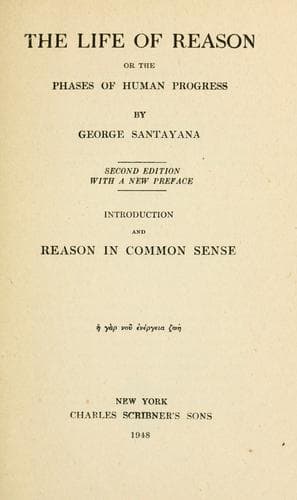
The Life of Reason: The Phases of Human ProgressSantayana, George
Philosophy
The Life of Reason: The Phases of Human Progress
Santayana, George
Philosophy
Institutions without men are as futile as men without institutions.
Before race can be a rational object for patriotism there must exist a
_traditional genius_, handed down by inheritance or else by adoption,
when the persons adopted can really appreciate the mysteries they are
initiated into. Blood could be disregarded, if only the political ideal
remained constant and progress was sustained, the laws being modified
only to preserve their spirit. A state lives in any case by exchanging
persons, and all spiritual life is maintained by exchanging expressions.
Life is a circulation; it can digest whatever materials will assume a
form already determined ideally and enable that form to come forth more
clearly and be determined in more particulars. Stagnant matter
necessarily decays and in effect is false to the spirit no less than a
spirit that changes is false to itself.
[Sidenote: Country well represented by domestic and civic religion.]
The spirit of a race is a mythical entity expressing the individual soul
in its most constant and profound instincts and expanding it in the
direction in which correct representation is most easily possible, in
the direction of ancestors, kinsmen, and descendants. In ancient cities,
where patriotism was intense, it was expressed in a tribal and civic
religion. The lares, the local gods, the deified heroes associated with
them, were either ancestors idealised or ideals of manhood taking the
form of patrons and supernatural protectors. Jupiter Capitolinus and the
Spirit of Rome were a single object. To worship Jupiter in that Capitol
was to dedicate oneself to the service of Rome. A foreigner could no
more share that devotion than a neighbour could share the religion of
the hearth without sharing by adoption the life of the family. Paganism
was the least artificial of religions and the most poetical; its myths
were comparatively transparent and what they expressed was comparatively
real. In that religion patriotism and family duties could take
imaginable forms, and those forms, apart from the inevitable tinge of
superstition which surrounded them, did not materially vitiate the
allegiance due to the actual forces on which human happiness depends.
[Sidenote: Misleading identification of country with government.]
[Sidenote: Sporting or belligerent patriotism.]
Public-domain text, read in full here on John Shaqi.
Reviews
Reviews
No reviews yet
Be the first to share your thoughts on this work.
Elsewhere in the archive
Join the Discussion
Join the discussion
Sign in to leave a comment or review.
Sign InorCreate an account