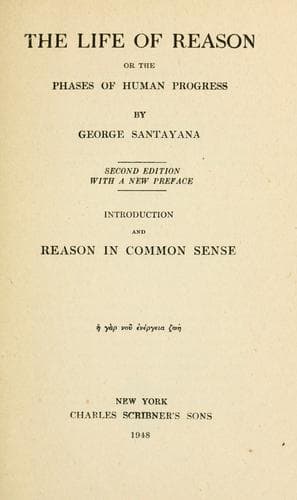
The Life of Reason: The Phases of Human ProgressSantayana, George
Philosophy
The Life of Reason: The Phases of Human Progress
Santayana, George
Philosophy
What has driven patriotism, as commonly felt and conceived, so far from
rational courses and has attached it to vapid objects has been the
initial illegitimacy of all governments. Under such circumstances,
patriotism is merely a passion for ascendency. Properly it animates the
army, the government, the aristocracy; from those circles it can
percolate, not perhaps without the help of some sophistry and
intimidation, into the mass of the people, who are told that their
government’s fortunes are their own. Now the rabble has a great
propensity to take sides, promptly and passionately, in any spectacular
contest; the least feeling of affinity, the slightest emotional
consonance, will turn the balance and divert in one direction
sympathetic forces which, for every practical purpose, might just as
well have rushed the other way. Most governments are in truth private
societies pitted against one another in the international arena and
giving meantime at home exhibitions of eloquence and more rarely of
enterprise; but the people’s passions are easily enlisted in such a
game, of course on the side of their own government, just as each
college or region backs its own athletes, even to the extent of paying
their bills. Nations give the same kind of support to their fighting
governments, and the sporting passions and illusions concerned are what,
in the national game, is called patriotism.
Where parties and governments are bad, as they are in most ages and
countries, it makes practically no difference to a community, apart from
local ravages, whether its own army or the enemy’s is victorious in war,
nor does it really affect any man’s welfare whether the party he happens
to belong to is in office or not. These issues concern, in such cases,
only the army itself, whose lives and fortunes are at stake, or the
official classes, who lose their places when their leaders fall from
power. The private citizen in any event continues in such countries to
pay a maximum of taxes and to suffer, in all his private interests, a
maximum of vexation and neglect. Nevertheless, because he has some son
at the front, some cousin in the government, or some historical
sentiment for the flag and the nominal essence of his country, the
oppressed subject will glow like the rest with patriotic ardour, and
will decry as dead to duty and honour anyone who points out how perverse
is this helpless allegiance to a government representing no public
interest.
[Sidenote: Exclusive patriotism rational only when the government
supported is universally beneficent.]
Public-domain text, read in full here on John Shaqi.
Reviews
Reviews
No reviews yet
Be the first to share your thoughts on this work.
Elsewhere in the archive
Join the Discussion
Join the discussion
Sign in to leave a comment or review.
Sign InorCreate an account