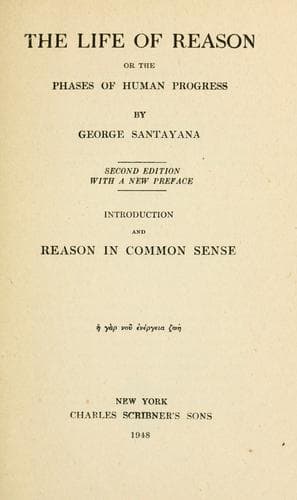
The Life of Reason: The Phases of Human ProgressSantayana, George
Philosophy
The Life of Reason: The Phases of Human Progress
Santayana, George
Philosophy
Mechanical forces, we must not weary of repeating, do not come merely to
vitiate the ideal; they come to create it. The historical background of
life is a part of its substance and the ideal can never grow
independently of its spreading roots. A sanctity hangs about the sources
of our being, whether physical, social, or imaginative. The ancients who
kissed the earth on returning to their native country expressed nobly
and passionately what every man feels for those regions and those
traditions whence the sap of his own life has been sucked in. There is a
profound friendliness in whatever revives primordial habits, however
they may have been overlaid with later sophistications. For this reason
the homelier words of a mother tongue, the more familiar assurances of
an ancestral religion, and the very savour of childhood’s dishes, remain
always a potent means to awaken emotion. Such ingrained influences, in
their vague totality, make a man’s true nationality. A government, in
order to represent the general interests of its subjects, must move in
sympathy with their habits and memories; it must respect their
idiosyncrasy for the same reason that it protects their lives. If
parting from a single object of love be, as it is, true dying, how much
more would a shifting of all the affections be death to the soul.
[Sidenote: They are not ends.]
Tenderness to such creative influences is a mark of profundity; it has
the same relation to political life that transcendentalism has to
science and morals; it shrinks back into radical facts, into centres of
vital radiation, and quickens the sense for inner origins. Nationality
is a natural force and a constituent in character which should be
reckoned with and by no means be allowed to miss those fruits which it
alone might bear; but, like the things it venerates, it is only a
starting-point for liberal life. Just as to be always talking about
transcendental points of reference, primordial reality, and the self to
which everything appears, though at first it might pass for spiritual
insight, is in the end nothing but pedantry and impotence, so to be
always harping on nationality is to convert what should be a recognition
of natural conditions into a ridiculous pride in one’s own oddities.
Nature has hidden the roots of things, and though botany must now and
then dig them up for the sake of comprehension, their place is still
under ground, if flowers and fruits are to be expected. The private
loyalties which a man must have toward his own people, grounding as they
alone can his morality and genius, need nevertheless to be seldom
paraded. Attention, when well directed, turns rather to making immanent
racial forces blossom out in the common medium and express themselves in
ways consonant with practical reason and universal progress. A man’s
feet must be planted in his country, but his eyes should survey the
world.
Public-domain text, read in full here on John Shaqi.
Reviews
Reviews
No reviews yet
Be the first to share your thoughts on this work.
Elsewhere in the archive
Join the Discussion
Join the discussion
Sign in to leave a comment or review.
Sign InorCreate an account