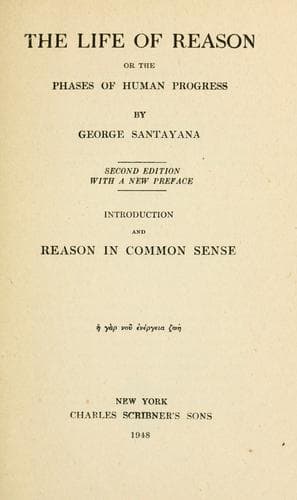
The Life of Reason: The Phases of Human ProgressSantayana, George
Philosophy
The Life of Reason: The Phases of Human Progress
Santayana, George
Philosophy
What a statesman might well aim at would be to give the special
sentiments and gifts of his countrymen such a turn that, while
continuing all vital traditions, they might find less and less of what
is human alien to their genius. Differences in nationality, founded on
race and habitat, must always subsist; but what has been superadded
artificially by ignorance and bigotry may be gradually abolished in view
of universal relations better understood. There is a certain plane on
which all races, if they reach it at all, must live in common, the plane
of morals and science; which is not to say that even in those activities
the mind betrays no racial accent. What is excluded from science and
morals is not variety, but contradiction. Any community which had begun
to cultivate the Life of Reason in those highest fields would tend to
live rationally on all subordinate levels also; for with science and
morality rationally applied the best possible use would be made of every
local and historical accident. Where traditions had some virtue or
necessity about them they would be preserved; where they were remediable
prejudices they would be superseded.
[Sidenote: The symbol for country may be a man and may become an idol.]
At the birth of society instincts existed, needful to the animal and
having a certain glorious impetuosity about them, which prompted common
action and speech, and a public morality, and men were led to construct
myths that might seem to justify this co-operation. Paternal authority
could easily suggest one symbol for social loyalty: the chief, probably
a venerable and imperious personage, could be called a father and obeyed
as a natural master. His command might by convention be regarded as an
expression of the common voice, just as the father’s will is by nature
the representative of his children’s interests. Again, the members of
each community were distinguished from their enemies by many a sign and
custom; these signs and customs might also become a graphic symbol for
the common life.
Public-domain text, read in full here on John Shaqi.
Reviews
Reviews
No reviews yet
Be the first to share your thoughts on this work.
Elsewhere in the archive
Join the Discussion
Join the discussion
Sign in to leave a comment or review.
Sign InorCreate an account